
May 1, 2026
By Anastasia Harouse – Policy & Research Intern
Anastasia Harouse is a graduate student at Carnegie Mellon University, pursuing a Master’s in Public Policy & Management – Data Analytics. She holds a B.S. in Data Science and Psychology from Chatham University and is passionate about exploring the impact of policy on local people, places, and communities.
May 1st marks the beginning of Asian American Pacific Islander (AAPI) Heritage Month. We naturally want to uplift the stories of AAPI individuals who shaped broader American society and Appalachia as we know it. For example, in Appalachian history, Japanese immigrant George Masa’s photography was instrumental in securing the designation of the Great Smoky Mountains as a National Park.
However, our heritage celebrations should also honor the everyday people who thrived in the same communities we do. These histories contain lessons that can guide us into the future, but they often fall outside the pages of American history books.
One such forgotten people lived in Pittsburgh’s Chinatown. This historic community faced immense institutional discrimination and was ultimately displaced by infrastructure development. This story serves as a reminder of the importance of responsible development and of how change must be led with respect for existing communities.
Origins of Pittsburgh’s Chinatown
In the late 1800s, a small community of Chinese immigrants, mainly from the southern Chinese cities of Hoiping and Toisan, settled in Pittsburgh. At the time, the U.S. enforced strict, racially discriminatory policies that prohibited the immigration of Chinese laborers but permitted merchants to enter the country. Despite intentional barriers, many Chinese immigrants persevered, finding a home in the heart of Downtown Pittsburgh.
At its peak in the early 1900s, Pittsburgh’s Chinatown consisted of an estimated 500 people living within the two-block area. This location was largely due to segregation, as Chinese immigrants often struggled to find housing elsewhere.
Their job opportunities were limited as well. Many Chinese worked in the service industry as grocery store merchants, laundrymen, and restaurant workers. The Chinese immigrants worked in these roles to comply with restrictive immigration policies that dictated who could legally enter the country and work based on occupation, specifically favoring merchants over laborers.
The community consisted mostly of single men because the U.S. immigration laws restricted Chinese women’s immigration. This limitation was due to stereotypes of Chinese women as sex workers. For decades, Chinese women generally could only enter the country if they could prove they were the wives of exempt merchants.
Despite these struggles, Pittsburgh’s Chinese immigrants created a vibrant community. They formed organizations such as the On Leong Merchants Association and the Consolidated Chinese Benevolent Association. These groups provided vital mutual aid and community support, such as sponsoring funerals and headstones that are still located in Homewood Cemetery.
Even with their limited job opportunities, the Chinese immigrants worked hard to start their own businesses. They operated more than 90 Chinese laundries and about 30 food establishments. These businesses would often receive financial and business support from the Chinese business associations, further illustrating the close-knit community.
A New Highway Divides a Thriving Community
The strong community had a well-established presence in the area, but the construction of the Boulevard of the Allies ran straight through Chinatown, displacing and literally dividing the community.
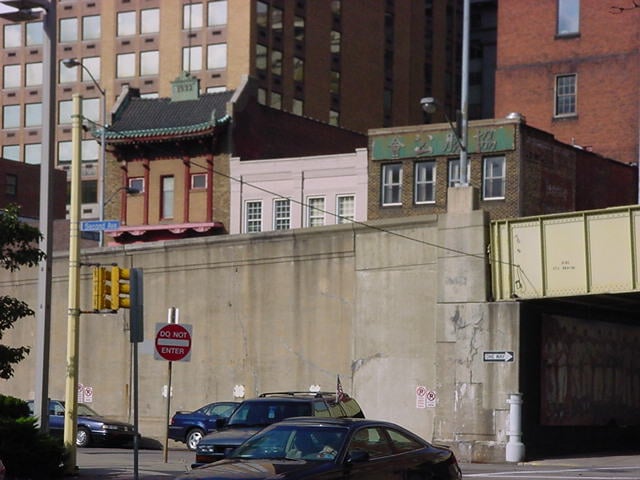
The Boulevard of the Allies is a major 3.5-mile road that connects Downtown Pittsburgh to the Oakland Neighborhood. During its development in 1922, it was the most expensive roadway in history, costing what would be $24 million today. Named in honor of World War I Allies, it was a symbol of American progress, providing an efficient throughway for automobiles, but it also led to the decline of Pittsburgh’s Chinatown.
Present-day historians attribute the Boulevard of the Allies to the dissolution of Pittsburgh’s Chinatown, but even during its construction in the 1920s, the broader Pittsburgh community was aware of its effects.
An archived newspaper from 1921 reported, “Several months ago there appeared Second Avenue representatives of the city, with plans under their arms and surveying instruments on their shoulders, who returned a verdict that part of Chinatown must go, to make room for the Boulevard of the Allies.”
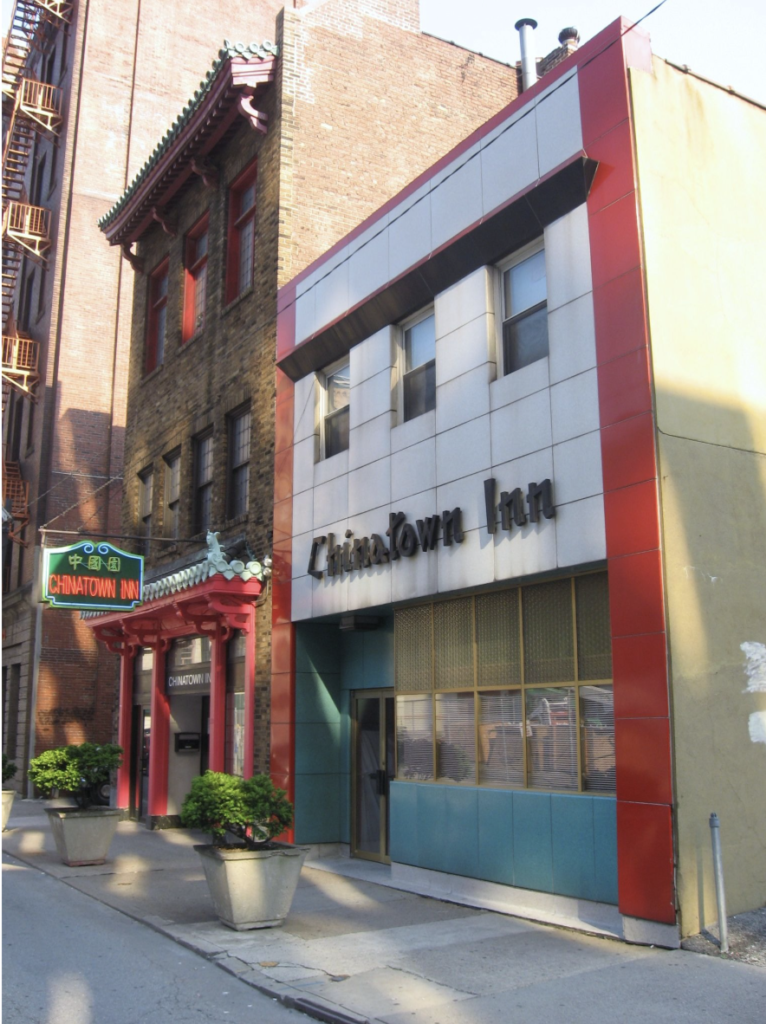
“PittsburghChinatown” by TheZachMorrisExperience, via Wikimedia Commons, licensed under CC BY-SA 3.0.
According to that source, Chinatown’s destruction was a mere afterthought and a worthy sacrifice for the sake of “modernity” and urban renewal.
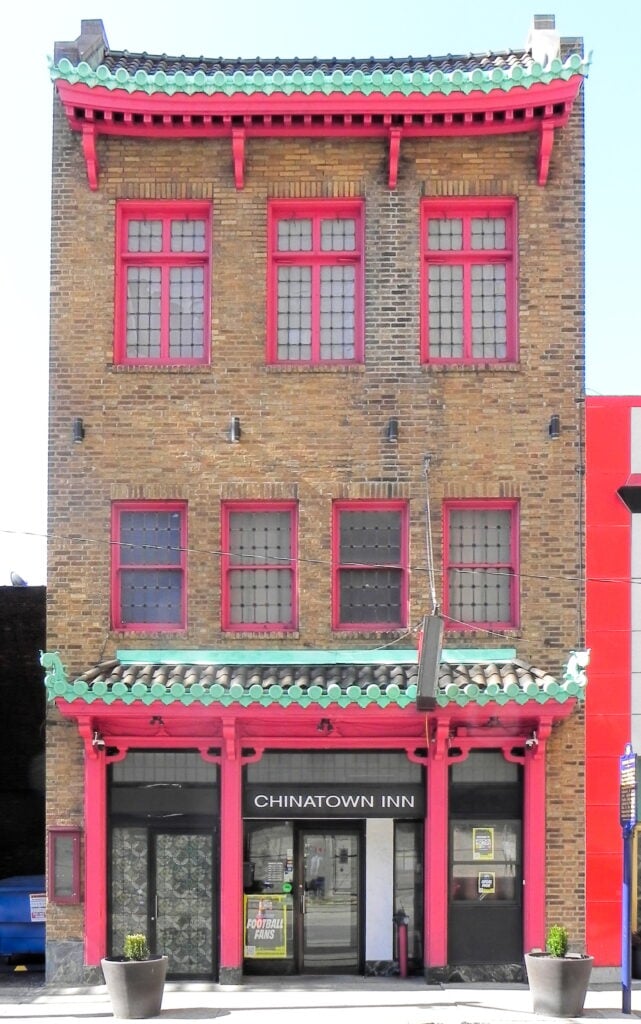
When construction of the Boulevard began in 1921, many families moved to nearby neighborhoods, suburbs, or other cities with larger Chinese communities. In the following decades, Pittsburgh’s Chinese population steadily declined. Now, only two buildings remain of Pittsburgh’s former Chinatown on Third Avenue.
Pittsburgh did not completely lose its Chinese population over time, but the current Chinese community here is not a direct continuation from those who lived in Chinatown. In 1965, the Johnson Administration abolished nation-based immigration quotas, allowing more Chinese immigrants into the U.S. The Chinatown residents were working-class immigrants who spoke Cantonese, but the newcomers tended to be college-educated, had higher socioeconomic statuses, worked in professional occupations, and spoke Mandarin, not Cantonese.
Pittsburgh’s Chinese Community Today
The legacy of the 1965 immigration reform is reflected in Pittsburgh’s current demographics. Currently, 7,000 Chinese-identifying individuals live in Pittsburgh. A majority of Pittsburgh’s Chinese are university students, with 4,555 international students studying at the University of Pittsburgh and Carnegie Mellon University.
Pittsburgh’s Chinese residents continue to build community through new organizations, such as the Organization of Chinese Americans and the Pittsburgh Chinese Cultural Center. Annual events, like the Pittsburgh Chinese Cultural Festival held each September in Mellon Park, ensure that Chinese culture remains visible, even without a Chinatown.
Pittsburgh’s Chinese Cultural Festival in Mellon Park, 2025. Photo by Anastasia Harouse
Equitable Development: A New Path Forward
As we look to the future, we must remember these stories of the communities that fought to be here before. Although the physical Chinatown has mostly disappeared from Pittsburgh’s physical infrastructure, we can find inspiration in the people who thrived even when institutional systems actively worked against them.
On a broader scale, new developments will always be planned, but we have the opportunity and responsibility to learn from our history. As we strive toward progress and innovation, we must think critically about the communities at stake and protect against displacement. Across the country, communities are fighting to remediate against actions like the ones that erased Pittsburgh’s Chinatown and prevent new harmful developments.
In New Orleans, the Claiborne Avenue Alliance is reimagining the Claiborne Avenue Corridor through thoughtful, equitable development after decades of harm from the Claiborne Expressway, which displaced a predominantly Black neighborhood in the 1960s. In West Virginia, Go North Corridor H advocates for an alternative route to the proposed highway expansion plan. Their plan aims to minimize harm to the natural environment, small towns, and local businesses. Across the country, urban and rural communities alike are challenging the legacy and continuance of irresponsible development.
Conclusion
The history of Pittsburgh’s Chinatown reveals displacement, structural barriers, and a warning tale of harmful infrastructure developments. It is also the story of a rich culture, community strength, and people who fought for their place in a society that disregarded them. At its core, it is a deeply Appalachian story.