

The West Virginia Mine Wars were a series of labor strikes that occurred throughout the early twentieth century in response to dangerous and unjust working conditions in the region’s coal mines. The workers responsible for fueling the nation and their families demanded safe working conditions and protection of basic rights. Their efforts and immense sacrifice during this time won hard-fought improvements in labor standards that still benefit workers today.
April 18 marks the anniversary of the Paint Creek-Cabin Creek strikes, the official beginning of the West Virginia Mine Wars. This month, we honor the anniversary of these strikes, recognizing how far we have come as well as the work that still needs to be done to stand up for workers’ rights.
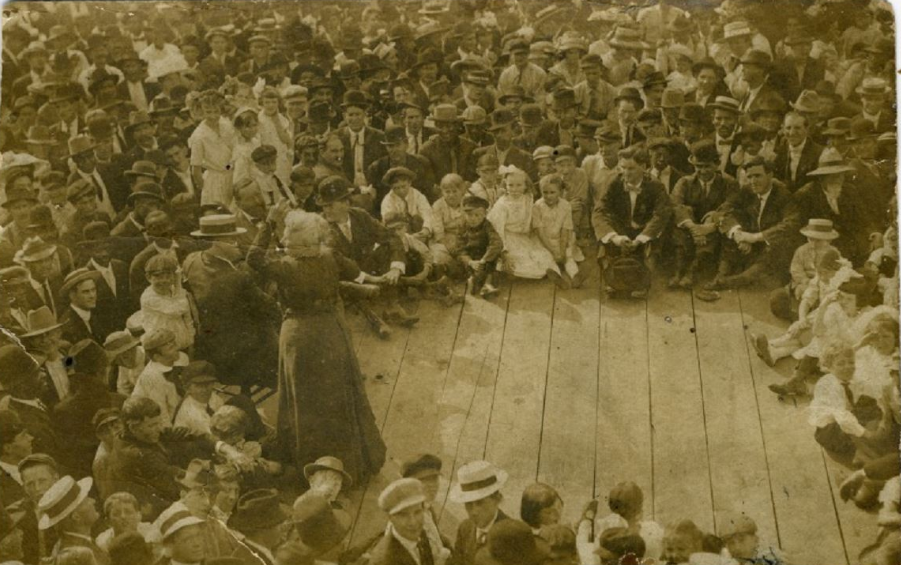
Mother Jones addressing workers in Montgomery West Virginia during the strike.
In this blog, we will touch on the key events within the Paint Creek-Cabin Creek Strikes, and we hope it inspires you to dig deeper into this important period in history that we cannot afford to forget.
What Happened?
Tensions that had been building for decades boiled over in 1912 when the Paint Creek mine operators denied a wage increase and refused to recognize the miners’ union. The miners’ demands were intended to address dangerous, unsanitary, and exploitative working and living conditions that they and their families faced on a daily basis. Most company town residents had limited access to clean water; they couldn’t keep dust and grime off of their food, and no matter how much they worked, they lived in perpetual poverty. The company operators and miners alike knew that union recognition would destabilize the carefully constructed system of company-owned housing, company stores, schools, and mine guards, which were used to control miners in all areas of their lives (read more here). Unionized workers in the Paint Creek Valley in Kanawha County were the first to go on strike. The Paint Creek miners reached out to the miners in nearby Cabin Creek, who had yet to unionize, and they soon joined the strike as well. The ensuing strike, which lasted over a year, brought violence for both sides as well as a major disruption to the coal mines that provided power to the industrialized nation.
The Paint Creek-Cabin Creek strikes involved many people who were or would become major figures in the realm of workers’ rights.
Mary Harris, “Mother Jones,” is one name that gets the recognition it deserves. What many people don’t know is that she joined the miners at the Paint Creek-Cabin Creek strikes, offering support for their cause.
Another key figure was Frank Keeney. Keeney, who had been working at Cabin Creek from the age of 10, took on a leadership role during the strike. Keeney continued to be a prominent advocate for labor rights throughout the WV Mine Wars, and by 1916, he was elected to be the president of the United Mine Workers District 17 in southern West Virginia. Today he is celebrated as a local West Virginia hero.
In addition to those who emerged as leaders, all of the striking miners showed bravery throughout the conflict. Strikers stood up against the Baldwin-Felts mine guards, guards employed by the private Baldwin-Felts Detective Agency, who were known to suppress mine strikes around the country using violent measures. The Paint Creek-Cabin Creek strikes didn’t just impact workers, though; the conflict spread to the miners’ families, and women and children also had to bear great challenges. Families were evicted from their homes, and they were forced to establish homes in the tent camp at Holly Grove.
The Bull Moose Special
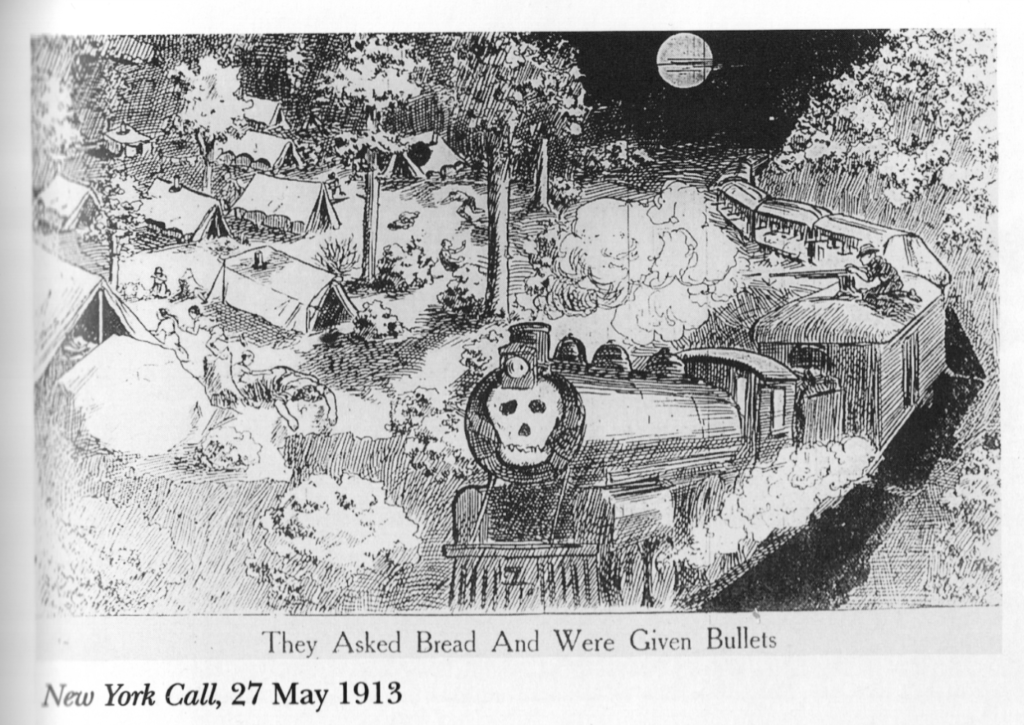
Image: https://drive.google.com/file/d/17os18xO3GOHWiQbKSDHGeB3cI4fOnJtv/view
One instance of terror occurred on the night of February 7, 1913, when the Bull Moose Special, an armored train loaded with machine guns used to bring in strike breakers, fired onto the unsuspecting miners and their families. The following passage, written by the West Virginia Encyclopedia, accounts for how a series of events during the day led to a night of terror.
”West Virginia Encyclopedia: The attack was triggered on February 7 when strikers from Holly Grove fired on a company ambulance and attacked the store at nearby Mucklow. Later that night, Kanawha County Sheriff Bonner Hill, Paint Creek coal operator Quinn Morton, a number of deputies, mine guards, and C&O Railway police boarded the Bull Moose Special armed with arrest warrants for unnamed persons. As the darkened train approached Holly Grove, two blasts from the engine’s whistle apparently signaled the beginning of machine gun and rifle fire from the Bull Moose Special into the tents of sleeping miners and their families. Several people were wounded, but only one striker, Cesco Estep, was killed. Estep was trying to get his son and pregnant wife to safety. In revenge, the enraged strikers attacked the mine guards’ camp at Mucklow two days later.” (see pg. 3 here)
Reading the testimony of Maud Estep, the wife of the murdered striker, Cesco Estep, conveys the confusion and horror of this night, and it serves as a reminder of the true human impact of this conflict. You can find her testimony here, starting on page 460.
Results of the Strike and Refusing to Settle
Following more than a year of violence, restrictions on daily life and mobility, the eviction of families, the destruction of personal property, injury, arrests, tragic death, and the unprecedented declaration of martial law to call in the state militia, Henry Hatfield replaced William E. Glasscock as Governor of West Virginia.
Governor Hatfield wanted to put an end to the strike that had become national news. He wrote a contract, which he presented to the miners and company operators. Hatfield’s contract did not include the terms demanded by the miners, and critically, it did not guarantee union recognition.
In light of these unacceptable conditions, the strike continued even after Hatfield compelled the miners to accept. Finally, after a renewed struggle, in July, the coal companies agreed to the miners’ original demands, and the unions at mines along Paint and Cabin Creek unions were at last recognized. (see here and here)
The West Virginia Mine Wars is not often discussed on a national scale, and yet, it was a pivotal period in the region’s and our country’s history that shaped the course of labor rights. This history was pushed aside and concealed for decades after it occurred. A key part of building on the work of the past is lifting up the true story of this strike, as told by the miners. There are groups working to uncover and teach others about this history. The West Virginia Mine Wars Museum in Matewan, West Virginia, is an expert on this era, and we encourage everyone to pay them a visit in person or virtually to find the most accurate and up-to-date information. Their lesson plans offer valuable resources that bridge key gaps in school curricula and provide information for lifelong learners as well.
The Paint Creek-Cabin Creek Strike made it clear that labor rights were important and that workers would not be silenced. This strike spurred a larger revolution that would eventually lead to more victories for workers’ rights, and it serves as a demonstration of what can be achieved through effective organizing. The Paint Creek-Cabin Creek Strike is also a reminder that history holds power, and honoring these stories is not only an act of remembrance but also a means of carrying the work of the past into the present and uplifting it into the future.