
October 22, 2026
Each community has its own rich history, and its own vision for the future it wants to see for itself. Brownfields are part of the story of where our communities have been. They should be part of the conversation about where we want to go next.
The community should have a seat at the table for decision-making. We can reclaim old lands and create new industry without creating a race to the bottom and undermining our community values. One of the most important steps in protecting our communities is to be prepared for the conversations and opportunities that are coming with new data center development.
Our goal for this blog is to lay out some of the dynamics at play at the intersection of data centers and brownfields.
One example, from Springdale, Pennsylvania, highlights the importance of communities preparing for large-scale projects such as AI data centers and planning optimal brownfield use. In Springdale, the local council felt pressured into a decision around data center development because local zoning codes were not updated.
Placing data centers on brownfields should include community engagement
Springdale, PA, is a small borough near Pittsburgh. It’s located on the Allegheny River where it was a long-time bustling railroad hub and a coal and steel industry residential area. It is the birthplace of environmentalist and Silent Spring author Rachel Carson, who was born in Springdale in 1907; her childhood home on Marion Avenue is preserved by the Rachel Carson Homestead Association. It is also home to the former Cheswick Generating Station, a coal-fired power plant that closed in 2022.
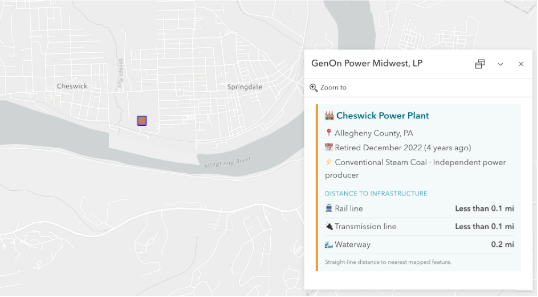
Since November 2025, it has also been home to a lot of controversy: that’s when the former Cheswick Generating Station was purchased to be redeveloped into a hyperscale AI data center. The project has been controversial, in part because of the local council feeling forced into approving the data center out of fear of being sued and forced into a worse deal if they didn’t.
The proposed data center project is welcomed by some as a source of new jobs and tax revenue; Springdale has seen its population decline as jobs left the area and the coal-fired power plant closed in 2022. But for others, the data center is seen as a bad fit for the town, especially since the site is adjacent to residential properties and a riverfront park. Aside from all these factors, it is troubling to see a town feel forced into a deal that they had little say in shaping; in the intervening months, the developer has conducted community outreach and made some changes to the initial proposal in response to concerns.
Can data centers be built on brownfields?
The short answer is yes. In fact, the Environmental Protection Agency offers a continuously updated guide on considerations for building data centers on brownfields. Proactive visioning and planning for brownfield redevelopment, with a diverse set of community stakeholders at the table, can help communities get out in front of any one proposed development project. ReImagine Appalachia advocates for comprehensive bottom-up community visioning for the region’s shuttered coal plants, and the federal resources needed to do so (see the handbook for redeveloping shuttered coal plants, and visioning for redevelopment).
Could data centers help promote economic diversification
In October, we hosted a webinar on data centers and brownfields, exploring one potential vision: Declaring shuttered coal plants and former industrial sites as “advanced industrial zones” where data centers might co-locate with other industries for shared clean and efficient energy, and waste management services (aka an eco-industrial park).
Could we get data center developers to help pave–and pay–the way towards this bigger vision?
What’s the work to make that happen? Answering these questions is a work in progress. Perhaps we need to advocate for state, local and/or federal policies declaring certain brownfields as “advanced industrial zones.” Like Opportunity zones, “advanced industrial zones” could be prioritized for responsible re-development incentives tied to specific requirements, starting with grant resources for bottom-up community visioning and planning for the site.
The first step, however, is to better understand the region’s brownfields and why they might be attractive to data center developers, consider the value of redeveloping brownfields over greenfields, and explore what truly sustainable or responsible development of these sites might mean.
What are brownfields?
The Environmental Protection Agency (EPA) defines brownfields as “a property where expansion, redevelopment, or reuse may be complicated by the presence or potential presence of hazardous substances, pollutants or contaminants.” This includes abandoned coal mines, coal-related waste sites, polluted watersheds, and many more.
As per EPA’s Re-powering Screening dataset–last updated in 2022–there were 35,067 brownfields in the country that met the definition.
For example, a former industrial site, a former laundry-mat, and a former gas station down the road can all be brownfields. You can learn more about brownfields at the EPA, and get technical assistance on brownfield redevelopment from groups like the Mid-Atlantic TAB, based at WVU, and learn about types of funding available for brownfield challenges here.
Does the Trump administration have a position on brownfields and data centers
The Trump administration has shown support for the concept through actions from day one of the presidency. In January 2025, President Trump signed Executive Order 14179 (EO) to support AI data centers. This order paved the way to ease environmental liabilities around brownfields. Last summer, via an executive order, the White House instructed the EPA to “expeditiously identify Brownfield Sites and Superfund Sites for use by Qualifying [Data Center] Projects.” In Sept. 2025, EPA Director Lee Zeldin stated in an op-ed that the EPA “promotes using remediated Brownfield and Superfund sites under EPA’s purview for data center development.” In January 2026, the EPA released special guidance and materials to encourage locating data centers on brownfield sites.
Should brownfields be considered for data centers over greenfields?
We’ve all seen increased protests over data centers. According to a report by Heatmap, 76 data centers representing at least $260 billion of data center investments were canceled in 2026 because of local opposition, as of October 2026. The report also found that 45% of data centers with sustained local progress were cancelled. Strong community pushback has made it a rare bipartisan issue, leading to hundreds of proposed moratoriums.
Proposed locations are one source of concern when it comes to data center development.
Historic farmlands, for example, are a controversial choice for data centers. American farm owners are receiving national attention for refusing to sell their lands to data centers; concerns have led to legislative proposals to block prime farmland from being sold to data centers.
Appalachia has many special and irreplaceable places where the highest and best use of that land is to preserve it for future generations. This may conflict with those wanting to introduce new development in the region. Brownfields are one way to allow new development and preserve greenfields.
Talks about responsible land use have swelled in the past couple of years with several policies and legislation offering incentives to speed up permitting processes if brownfields or other former industrial sites are selected for sites instead of undeveloped land.
What makes brownfields attractive to developers?
Established infrastructure, grid connection, and community eagerness for revitalization. Some of the most significant economic assets in coal communities are brownfields. These include former manufacturing sites and power plants that once served as a major source of good jobs and the foundation for the local tax base. Many brownfield sites are former industrial sites and possess industrial-grade infrastructure. These can include access to rail and water transportation networks and access to high-voltage energy grid infrastructure, which is a substantial initial cost for any industry hoping to build from scratch. Add access to water and sewage for the cherry on top.
We discuss the benefits of shuttered coal-fired power plants for future development in our ReImagining the Shuttered Coal Plant Handbook.
In addition, most brownfields exist because a tax-paying, job-creating entity has now left. Bringing new industry to these abandoned sites can help revitalize communities.
What are potential concerns about siting data centers on brownfields?
Environmental liabilities can be a wild card. These sites often remain unused because they pose environmental hazards, and dealing with them requires extra steps and special resources.
The re-use of brownfields for new industrial developments can lead to the re-exposure of residents to bad neighbors. Data centers can bring new pollution and other environmental burdens to communities. As discussed in this blog from NWF, many brownfields are in environmental justice communities, and it is important to ensure that new development has feedback from the local communities who have a real seat at the table to discuss how remediation and redevelopment of brownfields will not create additional burdens.
How can we better repurpose brownfields for more sustainable development?
Brownfields should always be the first option for new development – turning our old liabilities into new opportunities. Even better than re-using old sites solely for data centers, we can diversify the buildout by pairing a data center with a new industry, such as manufacturing.
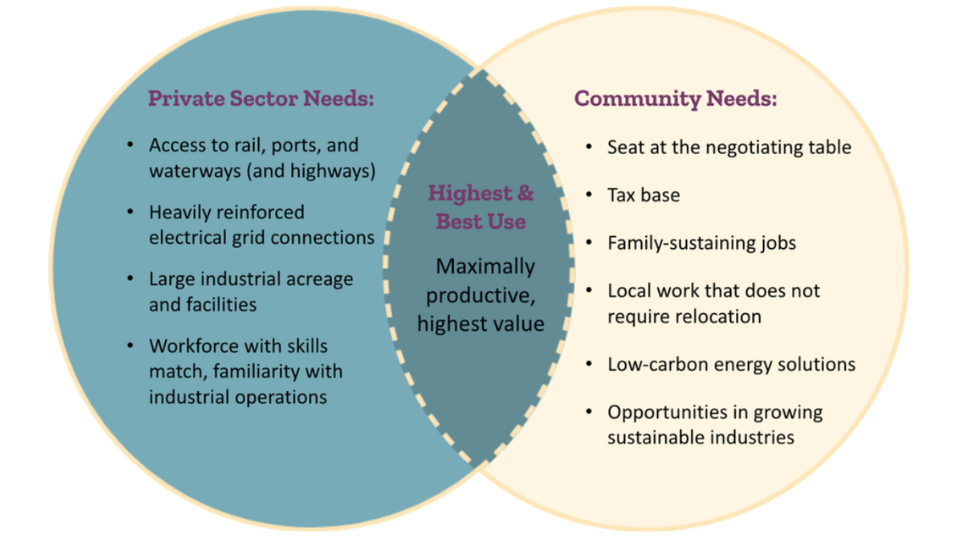
Sustainable development can be defined as when private sector interests and community benefits overlap.
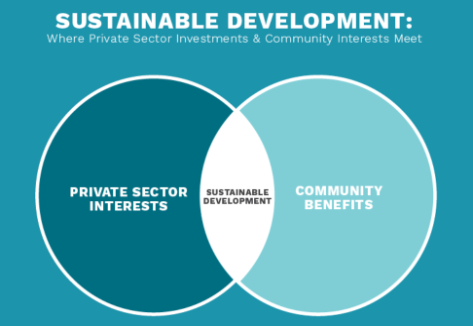
To ensure the highest and best use of former sites, there are key indicators that should be present, including:
- The project has been planned with meaningful community input
- The project is co-located with other industrial tenants such as manufacturing
- The project puts its waste heat to use, for instance, to heat co-located buildings or greenhouses
- The project brings its own energy and uses an energy mix with an emphasis on renewables and battery storage
- And more factors unique to each community.
You can learn more about how to bring communities together to discuss shared values around responsible development on our community benefits research page.
What can these principles look like when applied to a data center at a shuttered coal plant or other former industrial site?
Our communities have seen too many businesses boom, bust, take the profits and leave us with the damaged lands. In ReImagine Appalachia’s October webinar Jake Higdon, founding director of Advanced Industrial Zones on the concept of data center-anchored industrial zones, under which data center buildout can drive diversified economic development and job creation, to create long-term jobs past the short-term construction boom.
Similar values around making more diverse industrial sites that co-locate businesses on the same site can be found in our blog about new concepts for coal plant redevelopment led by architecture students at Penn State and in our waste-heat paper about how businesses co-located with data centers can make use of the waste heat. Our friends at PennFuture have outlined policies that could help support creative and diverse co-location of industries in their 2026 Energy Playbook: Building Our Energy Future.
How can communities prepare for data center development on brownfields?
When it comes to data center policy, we are building the plane while flying it. Where to start? One thing we hear again and again is that local ordinances and other strategies for responsible development are most effective when passed before a data center comes to town. Many ordinances to require responsible data center development contain common-sense approaches that are useful and relevant to any new development.
What is possible for local ordinances, as far as local control over development decisions goes, varies widely by state; our friends at Fair Shake have created tools to help guide communities in Pennsylvania, Ohio and West Virginia around data center development. For the Virginia context, the Southern Environmental Law Center, Getting It Right: Local Approaches to Data Center Development has advice for communities interested in increasing transparency and accountability around data center development.
ReImagine Appalachia has a blog that shares resources on local ordinances and other tools that can be used by communities to shape responsible development. We also have a blog with advice on steps communities can take to prevent data centers from becoming future brownfields.
In addition to strengthening local policy, good state and national policy is important to create a baseline.
Examples of data centers on brownfields in Appalachia
There is a growing trend among economic developers to propose data centers on brownfield sites. You can see the energy for this in the list below, which shows over a dozen data center projects proposed or in construction on brownfields in the region. Several of the projects will house on-site natural gas power plants. The number of projects on this list raises questions about whether all of these projects have gone through appropriate, transparent processes around development and approval. There are also questions about potential strains to the grid that these combined projects represent.
From our research, here are a handful of proposed data centers on former industrial sites as of early October 2026:
Click to interact with map showing where data centers have broken ground in the region.
Where are brownfields in Appalachia?
ReImagine Appalachia Analysis of EPA’s brownfields data identified 1,457 sites across 210 counties in the North Central Appalachian region with a cumulative acreage of 30,000. Thirty-five of these sites exceed 100 acres. On average, these sites are about half a mile from the nearest transmission lines, and every one of those lines was still in service when the data was compiled. The nearest substation is, on average, a mile away, with an average voltage of 116 kV. Substations in this range, typically the 115 kV class, are ideal for industrial customers and heavier operations like auto plants, steel mills, and data centers.
The breakdown of these 35 sites by Appalachian states is as follows:
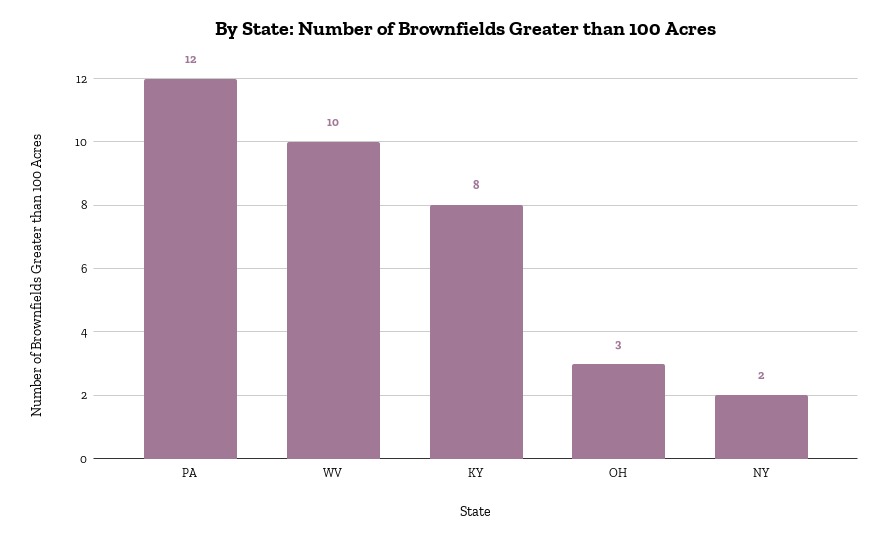
Click to interact with the brownfield map below.
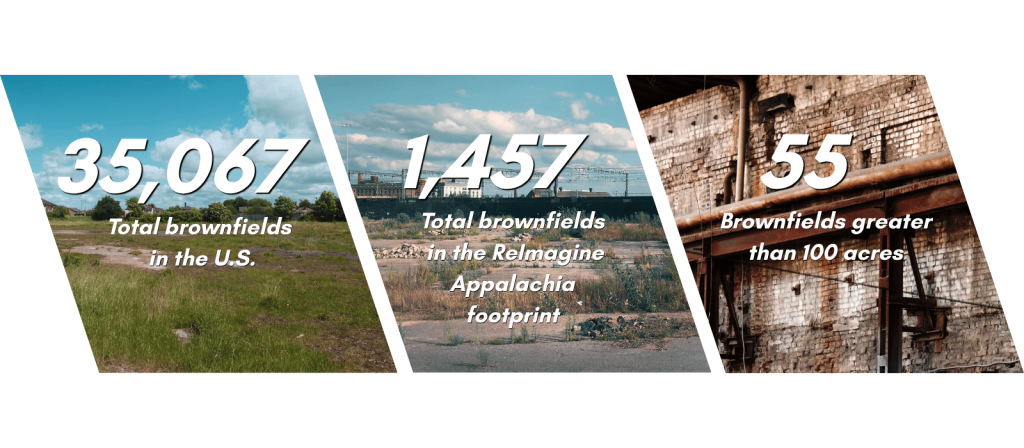
About 35 sites likely possess suitable conditions for data centers. However, that’s just the data part of the story. Each place has its unique relations with industry, and so it is important to engage with them to make sure there are community benefit agreements.
How can we ensure responsible development of brownfields?
We have acres of former industrial spaces in the region that burden our communities with dangerous liabilities and lost tax revenue. New developments must include community voices and should be rooted in a transparent process that brings real benefits back to the community.
For any community, data centers can be a huge undertaking. Brownfields and shuttered power plants are potentially the least controversial sites for new development, especially if government incentives align to make them more appealing. Still, some data center projects require rezoning and infrastructure improvements to roads, bridges, power grids, or water treatment plants before data centers can consider moving to a community.
Rural communities may also not have sufficient protections to mandate appropriate location of data centers or to ensure that data centers fit into long-term economic development plans. Local zoning authorities in these communities often provide the best—and sometimes only—opportunity to exert any meaningful influence over data center development. To assist communities, Fair Shake, Southern Environment Law Center, and Pennfuture have example zoning ordinances and considerations.