

Updated February 2026
The conversation about data centers is everywhere these days – as it should be. The explosive growth of this industry, while inevitable in the wake of artificial intelligence, is changing our communities across many dimensions and deserves careful consideration.
Attracting new industries to our communities should not be a race to the bottom; the new growth of data centers in the region is a call to assess how our policy models have historically favored economic and project development that benefits extractive, exploitative, absentee corporations at the expense of our communities, workers and lands. But there is a better way.
We can do economic development differently – in a way that is good for workers, communities and the environment. Data centers–with their intense and growing need for electricity that is pressuring our outdated electrical system and energy prices, producing massive amounts of waste heat threatening to pollute our waterways and ecosystem further, and creating construction jobs but little need for more permanent jobs–all require a new approach if we don’t want to repeat industrial development mistakes of the past. In response, numerous stakeholder groups have published or are in the process of publishing issue and position papers offering more responsible approaches to data center development.

In this blog, in order to start a broader conversation around responsible data center development across diverse stakeholder groups, we’re going to summarize some of the conversations we’re hearing from across our coalition – and some of the resources our partners are making to enable communities to have a seat at the table in determining how this industry takes shape.
Where are data centers headed?
The DOE, through NREL, released a map of data center infrastructure by county across the nation. It includes information to help you find data centers that are currently operating, under construction or planned and also includes information on anticipated energy demand, transmission line infrastructure and more. Another map that may be useful comes from FracTracker, and uses publicly accessible data to paint a detailed picture of where data centers are being located.
The scale of data centers impact is hard to fathom. While other construction markets, like commercial real-estate construction, are looking flat for 2026, spending on data center construction is expected to increase by 23% in 2026.
That growth has created a ripple effect for other sectors, resulting in shortages of specialized trades workers, such electricians, environmental impacts from the metric tons of concrete needed, shifts in the battery industry to boost grid-scale battery production for data centers, and increased prices for memory chips that will likely impact the cost of items from computers to smartphones to cars.
This dramatic growth naturally leads to questions about whether there is a “data center bubble” happening. While it’s impossible to predict the future, recent reports like Bubble or Nothing by the Center for Public Enterprise provide useful insight into the financing, investment models and possible warning signs, including the increasingly large role of debt in financing data centers.
Appalachian manufacturers should be a part of the data center supply chain:
Components for data centers should be procured locally if at all possible, so that the creation of these components contributes to the region’s manufacturing sector. Our partners at Catalyst Connection recently published this report and a series of webinars on the potential for small and mid-sized manufacturers (SMMs) to integrate with this new supply chain.
Data centers use a lot of electricity – and create a lot of heat:
You’ve probably heard by now that data centers are major energy users – so much so that they are prompting a need for us to completely re-think the United States energy sector. According to new analysis from MIT Technology Review, AI data centers now consume 4.4% of all U.S. energy, with some projections showing AI alone could use as much electricity as 22% of U.S. households by 2028, other projections show up to up to 12% of total by 2028. These centers typically use electricity that’s 48% more carbon-intensive than the U.S. average electricity usage. This relates largely to the speed at which they are being built, since hastily built data centers don’t leave time to develop a corresponding renewable energy network.
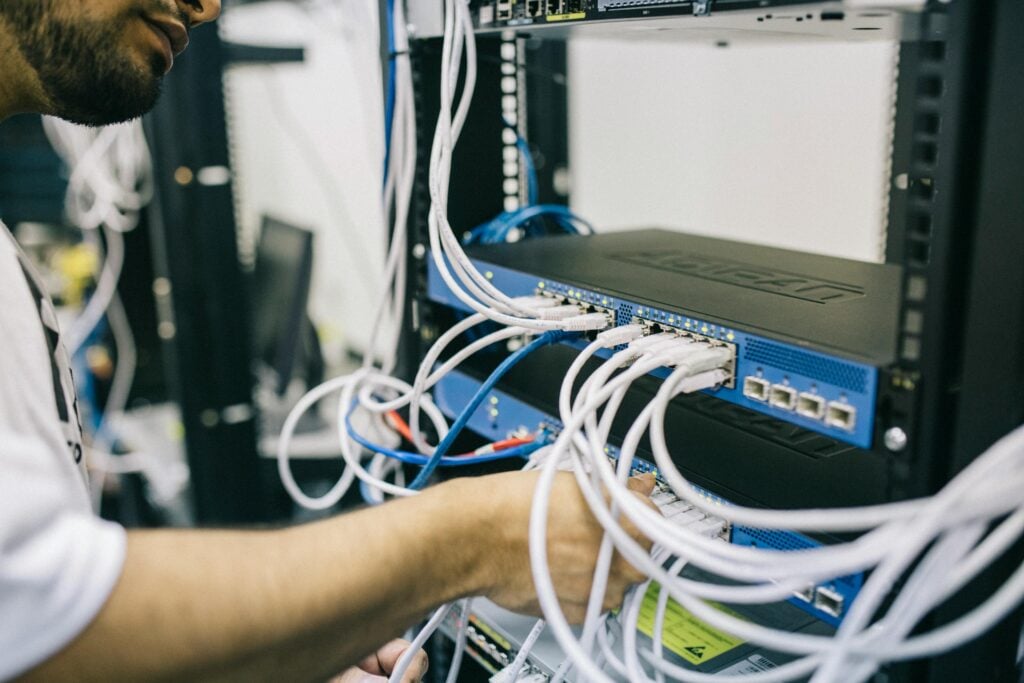
While many are well aware of the amount of electricity data centers use, people often overlook the waste heat emissions and their impact. Data centers generate significant amounts of waste heat due to the high energy consumption of their servers and cooling systems. Instead of dissipating this heat into the environment, as is often done, it can be recovered and used for other purposes.
One opportunity to make data centers a better neighbor is to locate them on shuttered industrial facilities, such as former coal plants (rather than greenfields). This concept is discussed in this PNNL Factsheet. Ideally, data centers at shuttered facilities would be co-located with factories or other entities like greenhouses that can benefit from data center waste heat. This reduces their reliance on traditional heating methods, supports energy efficiency and energy savings, and gives the shuttered facility a new purpose. Shuttered coal plants, and many former industrial sites, also have access to heavily reinforced electrical grid infrastructure (along with other reusable assets), reducing the need for on-site electrical system upgrades.
Waste heat recovery can significantly reduce the carbon footprint of both data centers and nearby facilities by minimizing energy consumption from traditional heating methods. For example, in Marietta, OH, an innovative pilot program will use the waste heat from a data center to heat a nearby greenhouse.
Overall, waste heat recovery can significantly reduce the carbon footprint of both data centers and nearby facilities by minimizing energy consumption from traditional heating methods. In February 2026, ReImagine Appalachia released a report titled Catching Heat: The Opportunities and Challenges of Using Waste Heat from Appalachian AI Data Centers that details the potential for waste heat to be used for heating buildings, community facilities, and agricultural operations and other strategies, as well as the policy frameworks needed to increase the adoption of waste heat capturing for economic and community benefits.
Forthcoming research from ReImagine Appalachia will go into more details about the potential for waste heat to be used for heating buildings, community facilities, and agricultural operations and other strategies, as well as the policy frameworks needed to increase the adoption of waste heat capturing for economic and community benefits.
New report – Catching Heat: Using Waste Heat Generated from Data Centers
Good local policy can protect communities, workers and ecosystem:
Policy in our nation has been slow to catch up to the data center boom, however, advocates are working to create guidance to help our communities get up to speed.
The scale of data centers presents a huge learning curve for our communities. The following resources from our partners may be helpful in helping communities navigate some of the complexities that stem from data centers.
Quick overview of options: This resource from Fair Shake Environmental Legal Services, Data Centers – How Municipalities Can Prepare, offers a quick overview of a range of options that municipalities can use to address common data center concerns, including community benefit processes.
Zoning ordinances: Our friends at PennFuture have created a series of videos showing considerations communities should keep in mind when a potential data center comes to town. They have also created a model zoning ordinance with suggested provisions addressing water consumption, power consumption, noise, and aesthetic concerns.
Toolkit with example policies: The organization Climate Mayors released a new resource titled Data Centers and the Climate Landscape: An Actionable Resource for US Mayors in January 2026. This resource draws knowledge from Climate Mayors across the nation and includes case studies and practical information to help influence data center development outcomes through local policy and strategies when authority is limited or shared with states, utilities, or regional bodies.
Strategies for Transparency and Accountability: Though this resource from the Southern Environmental Law Center is rooted in learnings from work in Virginia, the lessons in Getting It Right; Local Approaches to Data Center Development provide strategies for how local governments and community members can increase transparency and accountability around data center development. In this new report, including how local zoning ordinances can effectively empower local governing bodies — and by extension, the public — to address data center development in an informed, responsible, and transparent way.
Addressing Strains to the Grid and Energy Costs: This report by Young, Gifted and Green and RMI, titled Lightening the Load: Scaling Clean Solutions for Data Centers and Communities explores case studies of how clean energy solutions can be incorporated into data center development.
Community Input, Job Access and Labor Standards: While there are few jobs in completed data centers, we should ensure that any jobs created are good jobs and local workers have access to them. Data from Business Insider show that most data center jobs are in construction, and often contracted from outside the places the centers are located. Strong labor standards are key to ensure that local workers are hired in the development and construction of new sites. This Brookings report outlines why community benefits are an important part of data center development. ReImagine Appalachia’s Economic, Community and Project Development Principles contain examples for strong labor standards during the construction of these sites. The NAACP has created a community benefits template, designed with data centers in mind. It is important to ensure policy includes issues such as prevailing wage, responsible bidder policies, project labor agreements, registered apprenticeship and the prevention of wage theft.
Principles for reform: In Virginia, which is home to the world’s highest concentration of data centers, the Piedmont Environmental Council and the Virginia Data Center Reform Coalition have drawn on their first hand experience to create four principles of data center reform. The principles includeenhanced transparency for issues like energy use, water consumption and emissions from data centers, state oversight to evaluate the regional impacts of data centers, protections for families and businesses, to assess risks and costs associated with data centers and ensure that residents are not shouldering those expenses, andincentives for efficiency. Data centers can use as much power as a small city; higher standards to use clean energy, energy efficiency, and practices like co-location should be encouraged to reduce the power load.
Environmental and Climate Justice Principles. Another set of guiding principles as well as organizing tools has recently been released by the NAACP; this set of principles follows a convening in Memphis, Tennessee of nearly 70 climate and community advocates, including those who have been engaged with community issues surrounding the South Memphis Data Center. One issue called for includes transparency and legally binding accountability for any commitments, such as those on water use, energy consumption, emissions, and tax breaks.
Mitigating Pressure on Energy Prices – Recommendations. A guide from the Natural Resources Defense Council (NRDC) includes policy recommendations to help mitigate the impacts that data center growth will have on our nation’s electrical grid; as well as on consumer’s electric bills. Common sense policies can help incentivize data centers to adhere to best practices and help our government to assess, plan, and build smarter energy systems with expanded and upgraded transmission infrastructure, battery storage, and renewables.
The importance of strong state policy:
A survey of tax incentives by GoodJobsFirst found that 36 states have implemented tax breaks for data centers; some of which include requirements for community benefits, job creation requirements, and other standards to help ensure that communities have a seat at the table with new projects that come to their town. More information on Data Center Incentives can be found in this resource by the National Conference of State Legislatures.
However, many of these tax incentives do not include meaningful development standards, and some deliberately exclude communities from having a say in local development. One of the more troubling examples of data center policies comes from West Virginia. In May 2024, the Governor of WV signed HB 2014 into law; this bill removes local government control over issues like property taxes, zoning ordinances and more. This takes away an important source of local revenue, even as data centers increase the needs for public services that local governments provide. The goal of the bill is to make West Virginia the most welcoming state in the US for data centers, but it has instead left communities without oversight or input into new projects and at the mercy of bad actors. Each state faces its own unique landscape of challenges, requiring advocates and policymakers to prioritize different factors in their legislative approaches to regulating these facilities. The Sierra Club has created a Data Centers State Policies guide for 2026, that includes example state legislation around key issues such as transparency, electricity rates, and more. In 2025, Climate-Xchange tracked over 140 state legislature bills that addressed data centers. While new legislation is necessary to address the many new complications that data centers bring, the scale presents a challenge to communities and lawmakers alike.
Looking forward
We must move towards basic development standards designed to ensure projects truly benefit local workers and residents. New policies could help ensure that data centers pay fair electricity rates and taxes; build additive, new, local clean energy and transmission to be shared with communities; use sustainable water technologies; innovate in waste-heat practices, treat workers fairly, and contribute to the local tax base and deliver community-defined benefits.
If we combine forces to jointly develop a model responsible data center development policy position, maybe we can collectively put an end to the race to the bottom already in progress in places like West Virginia.
Who out there is on board to do data center development differently?