

We come together at the start of each year, as a coalition of diverse stakeholder groups, to find common ground, remember our common humanity and build on a collective vision for a more prosperous Appalachia–an economy that is good for workers, communities, the region’s lands and the air we breathe.
In 2026, given the many changes at the federal level, the question in front of us at this troubled moment in time, is how and where can we continue to make progress towards the things we care about–modernizing the region’s infrastructure, promoting good union jobs, building pathways out of poverty for low-income communities–and, ultimately, sharing a story of hope.
No one person has all the answers. The annual strategy summit is designed to create space for the dialogue needed to put together a regional plan of action.
Where can we make progress for Appalachia in 2026?

Attendee feedback on Mentimeter.
On day one, we started with a fireside chat with some of the region’s most innovative and eloquent leaders to inspire us with why Appalachia matters in the bigger national and global context. We also had a panel of experts give us their thoughts on the work we need to do to drive increased private and philanthropic investments into Appalachia. We dug into the work we need to do to drive an Appalachian manufacturing action plan, promote more responsible data center development, and secure flood resiliency resources.
In recognition that everyone is an expert in some way, we also polled attendees and hosted facilitated breakout discussions to gather the thoughts and ideas from a broad array of stakeholders in the region for the work we need to do together in 2026. We recorded the panels and breakout sessions while also taking extensive notes and saving the chats and mentimeter results.
This blog is meant to provide an overview of the polling results and discussion highlights, while also providing links to recordings and detailed notes. We are now in the process of using these materials to update and inform the coalition’s 2026 strategy and workplan.
Our theory of organizing is that the more input we have, the better the plan, and hopefully the more people ready, willing, able, even excited to join together to move toward common goals with a more unified voice and greater collective leverage.
Day 1: Appalachia Matters
Fireside Chat: Appalachia Matters
Panelists:
- Moderator: Heidi Binko, CEO, Just Transition Fund
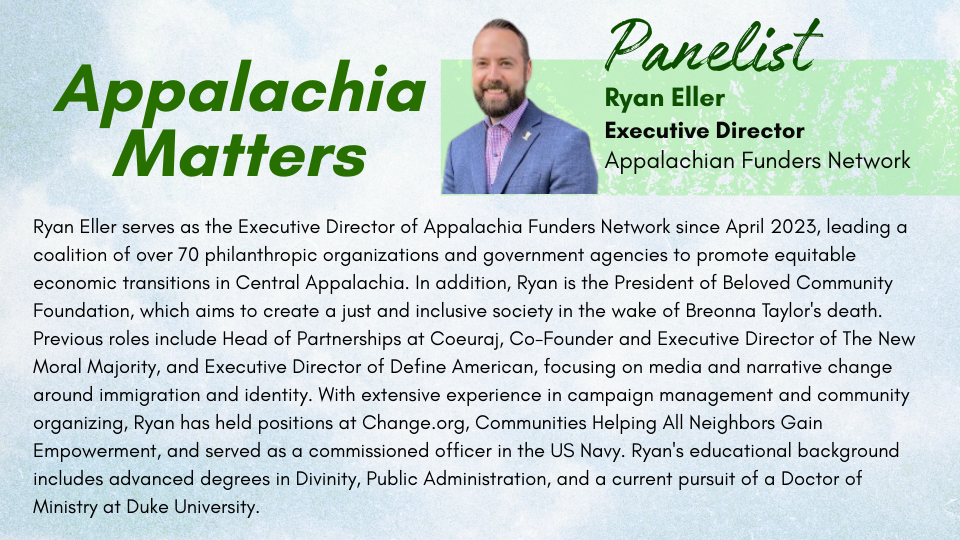
- Ryan Eller, Executive Director, Appalachian Funders Network
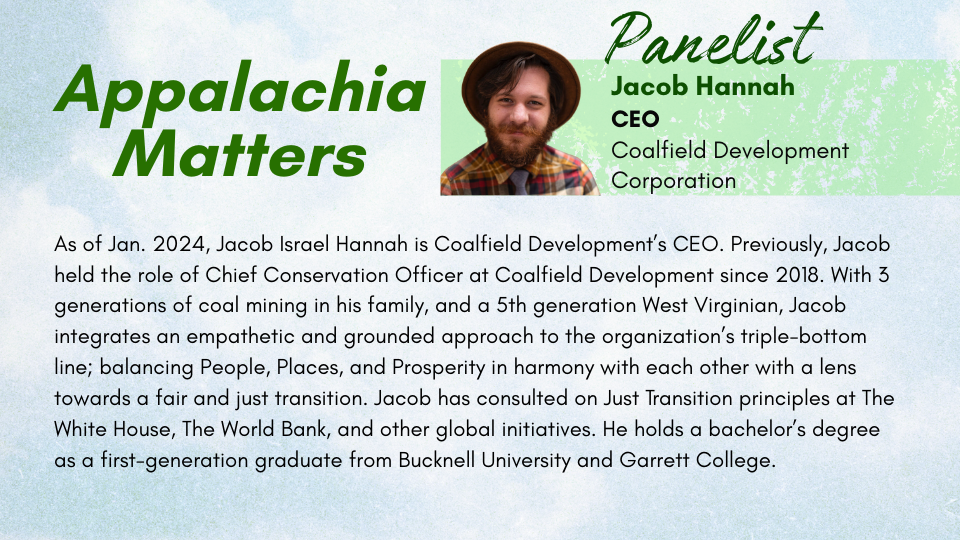
- Jacob Hannah, CEO, Coalfield Development
Click and drag images to swipe through panelists (click images to pause motion)
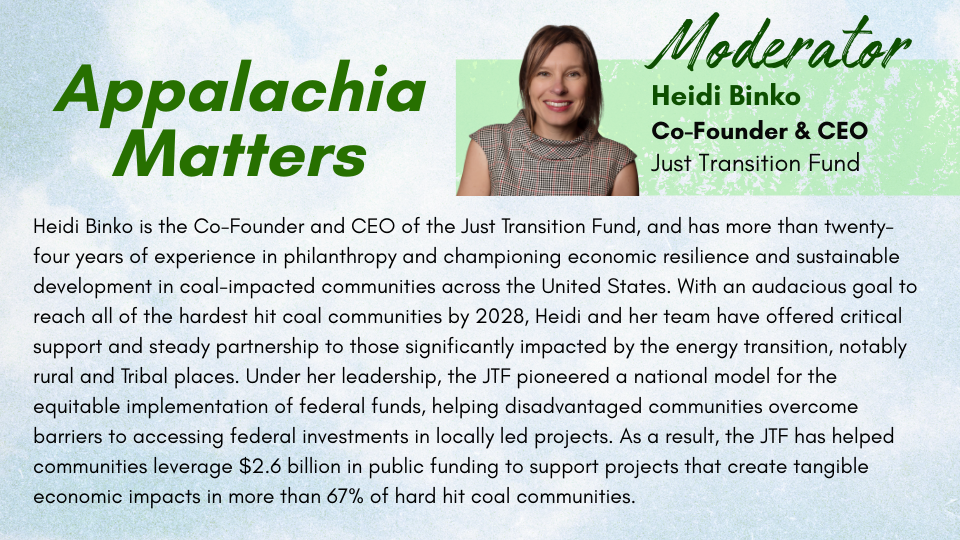
CEO and Founder of the Just Transition Fund, Heidi Binko, reflected on the changing nature of investment in recent years. Following high levels of federal investment two years ago, 2025 was marked as a year of uncertainty. At the start of 2026, Heidi acknowledged that we have seen some tough times, but she encouraged us to move through the challenges and focus on new bright spot opportunities for the region. Once those bright spots are identified, we must turn to planning because, in Heidi’s wise words, “If there is no plan, there is no progress.”

Ryan M. Eller, Executive Director of Appalachian Funders’ Network, reflected that during this pivotal inflection point, our country as a whole needs Appalachia more than ever. The Appalachian region offers other places a key example of how to reclaim local identity and create a sense of collective community supported by innovative local funders and community foundations.
Jacob Hannah, CEO of Coalfield Development agreed that Appalachia serves as a cultural touchstone for the nation as it is often called on as an example to reflect what is going right and wrong within national political conversations. Appalachia can also be viewed as an ecological touchstone in light of the recent rise in severe natural disasters like flooding; these events offer an environmental warning to the rest of the country and even world. Lastly, Jacob identified Appalachia as an important energy touchstone as it is a region that is at the forefront of trying to figure out what comes next for energy generation.

Key priorities our speakers noted for the coming year:
- Focus on collaborations in the region -instead of focusing on pulling money down from the federal government right now, what are lateral ways we can support each other in the coming year?
- Creative local funding solutions for community projects could inspire essential place-based philanthropy and diversify funding streams.
- Creating climate resilient hubs that support the growing disaster relief economy is one particular area for development that stands out for Appalachia.
- Though there are risks, with the right mobilization and negotiations now, AI data centers could offer an opportunity to ensure that related jobs are local and locally controlled instead of extractive as many fear they could be.
- Fight political polarization by centering people above politics.
Key themes of the discussion:
Find the bright spots:
Ryan called our attention to the great work being done by Appalachian Community Capital’s “Opportunity Appalachia.” He also celebrated Coalfield Development’s work to reverse the idea that it is impossible to do anything on abandoned mine lands by successfully redeveloping abandoned sites into much-needed innovative and flood resilient projects like regenerative housing.
Prioritize collective visioning:
Jacob encouraged communities to continue the work of reimagining their communities, focusing on identifying strong areas of passion that make the community unique in order to help center the visioning process. Ryan echoed this idea, and offered that the first step is to always to simply show up in spite of the current barriers and doubt that may exist. The spirit of historic resilience can be harnessed to create unity in these polarized times. ReImagine Appalachia as well as our partners at the West Virginia Community Hub, BRECC, and IWG have specific resources that can help with community visioning. There will be opportunities in the future, one way or another, and we can be ready for them.
Educate Philanthropy on why Appalachia Matters:
National philanthropy has shown interest in Appalachia, but they need education as well as bridge building. While humility is often a strength for Appalachia, when speaking with funders, Appalachia needs to present itself with confidence. This could mean inviting funders to visit the community and project sites to demonstrate local capability. Both Jacob and Ryan suggested that Appalachian communities approach national funders with local and regional partners, especially those who have been funded in the past.
Both funders and allies can be encouraged to understand the theory of change of resilient, diverse economies and the importance of community-led, bottom up visioning. It is also important to communicate the importance oflong-term, regenerative philanthropic investment instead of volatile federal funds, sustaining civic infrastructure including community spaces and local news, and acting as an example for the nation. With the right focus, attention and resources, Coal Country can become leaders of the new energy economy, permanently changing the national paradigm.
Facilitated Breakout Discussions Round 1
▼ Click the tabs below to view different workshops and access recordings
▼
Investment
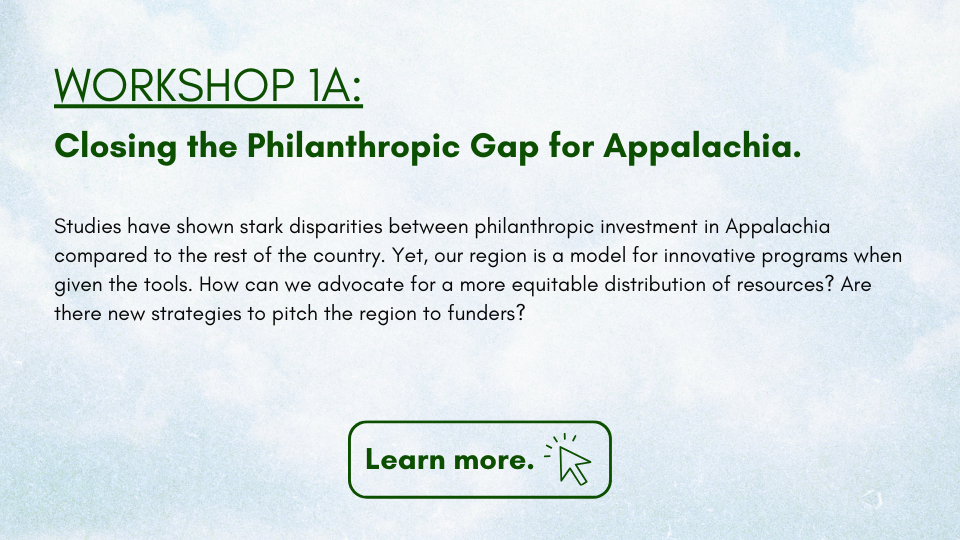
Workshop 1A
Responsible
Development
Workshop 1B
▼
Communications
Workshop 1C
▼
Policy
Workshop 1D
▼
Research
Workshop 1E

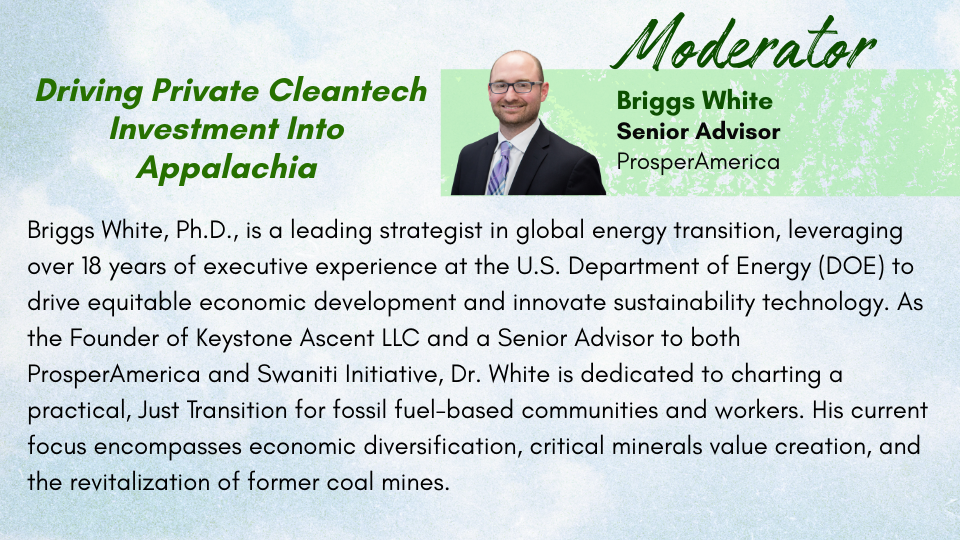
Panel Discussion: Driving private cleantech investments into the Ohio River Valley of Appalachia (aka coal country)
Panelists:
- Moderator: Briggs White, Senior Advisor, ProsperAmerica
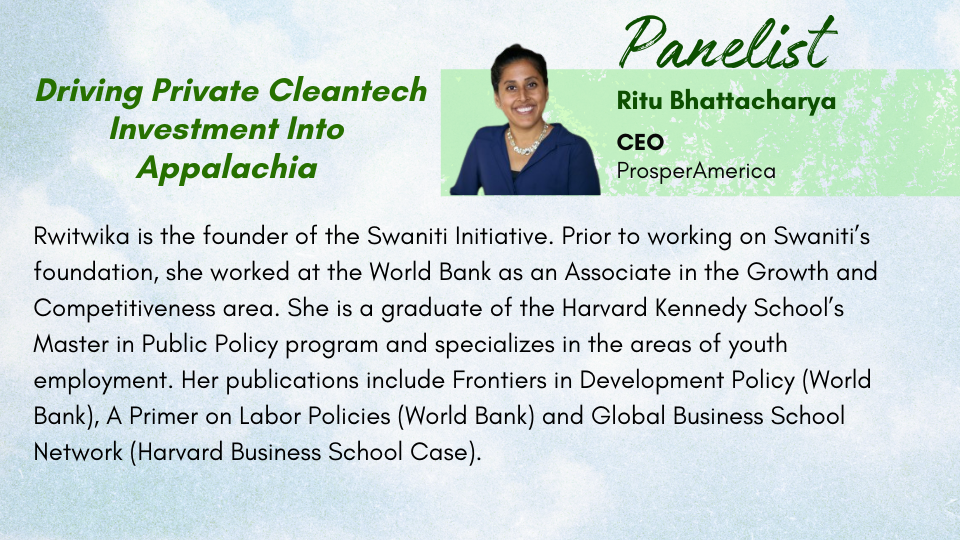
- Ritu Bhattacharya, CEO, ProsperAmerica
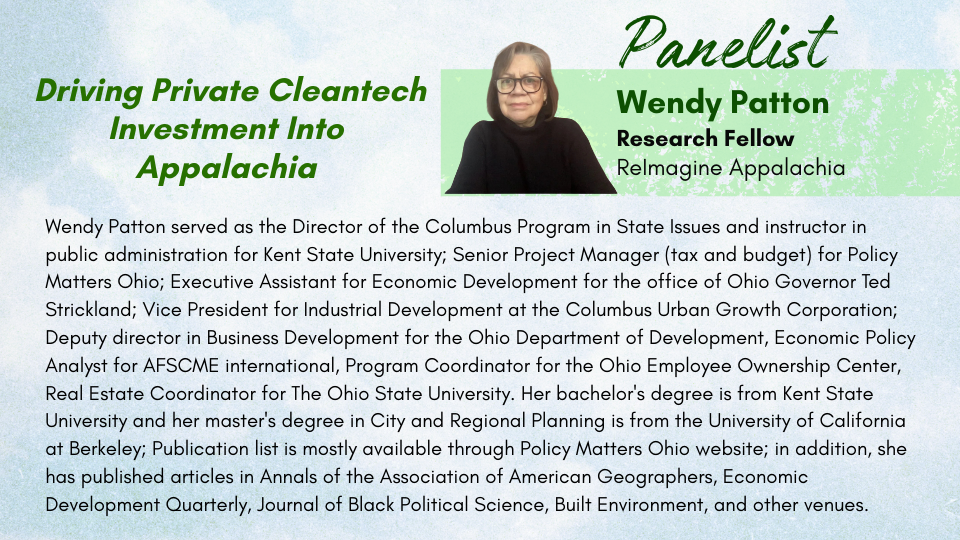
- Wendy Patton, Research Fellow, ReImagine Appalachia
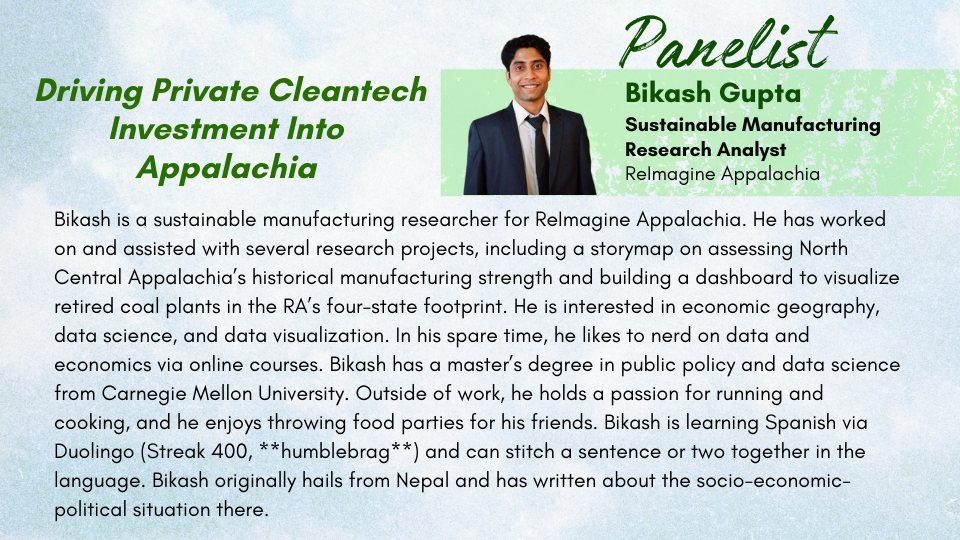
- Bikash Gupta, Sustainable Manufacturing Research Analyst, ReImagine Appalachia
- Sam Miller, Development Director, Buckeye Hills Regional Council
Click and drag images to swipe through panelists (click images to pause motion)

Recording:
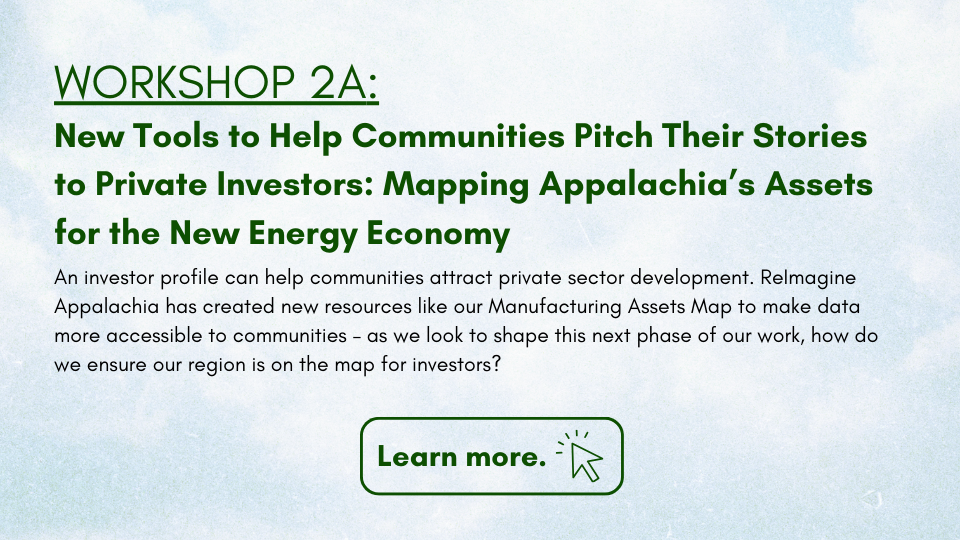
What’s next? Partners are excited by the storymap’s potential to create new connections with the private sector. Next steps in this pilot will involve education to ensure communities know how to navigate the storymap and get the most out of this innovative tool. Long term, groups would like to explore ways to scale this pilot project to more communities.
In response to the question “What value and assets does Appalachia offer private investors,” participants highlighted workforce, natural resources, and resilience as particular strengths.
What value/assets does Appalachia offer private investors?
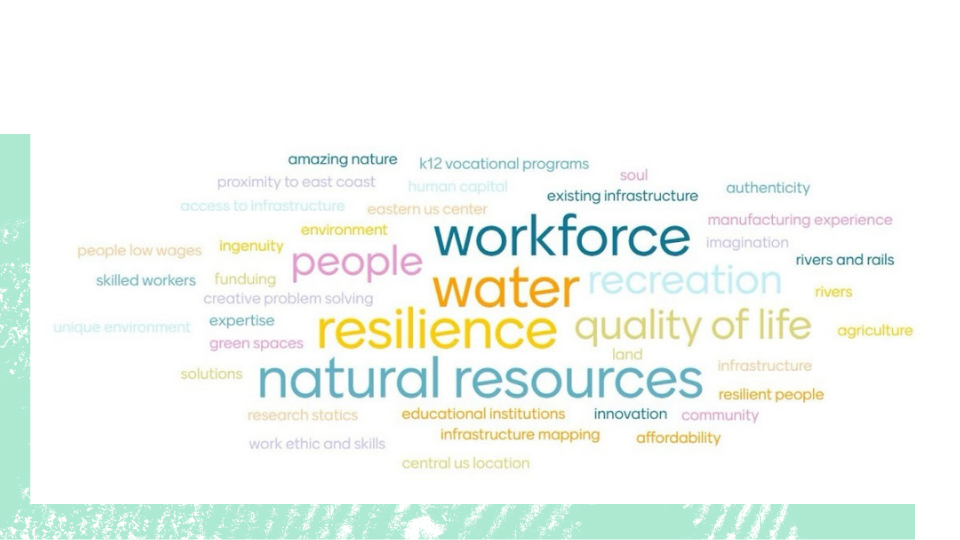
Attendee feedback on Mentimeter.
Facilitated Breakout Discussions Round 2
▼ Click the tabs below to view different workshops and access recordings
▼
Investment
Workshop 2A
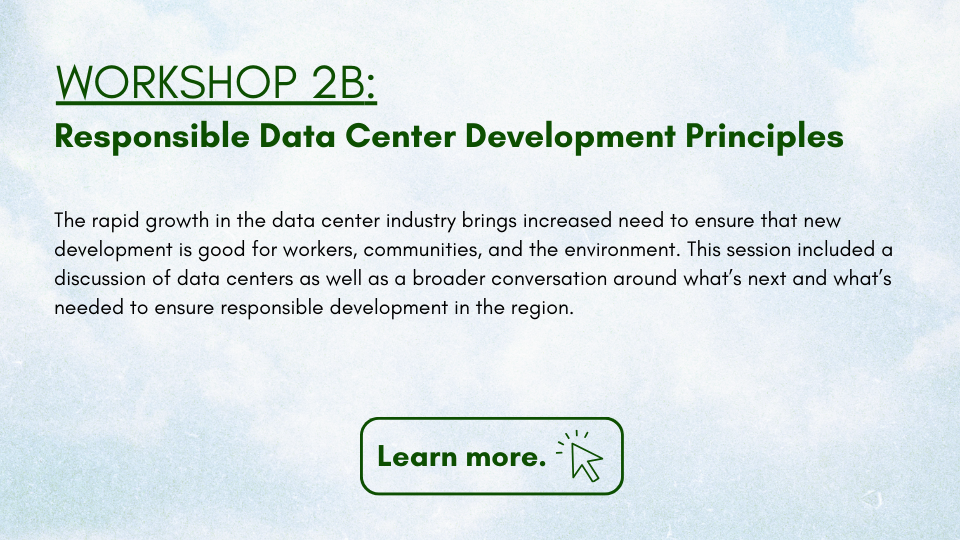
Responsible
Development
Workshop 2B
▼
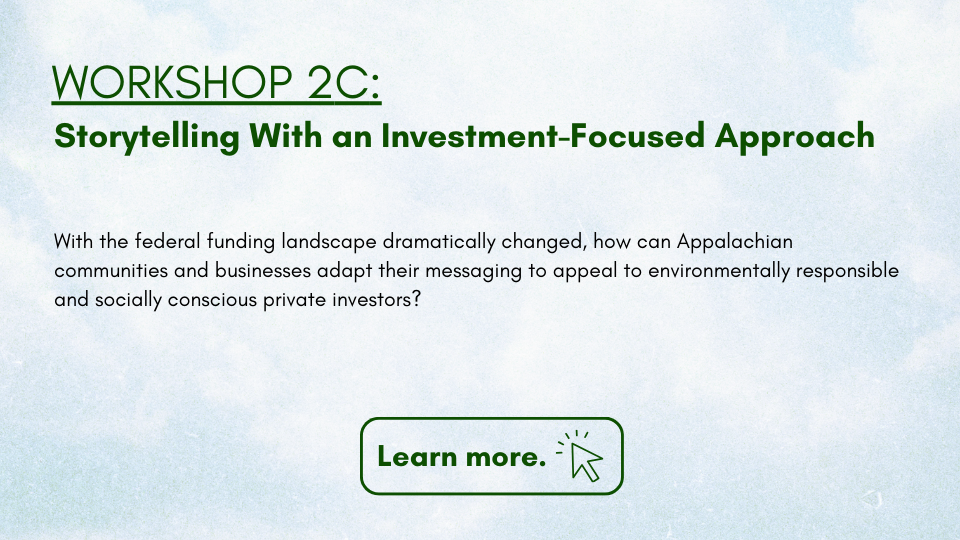
Communications
Workshop 2C
▼
Manufacturing
Workshop 2D
▼
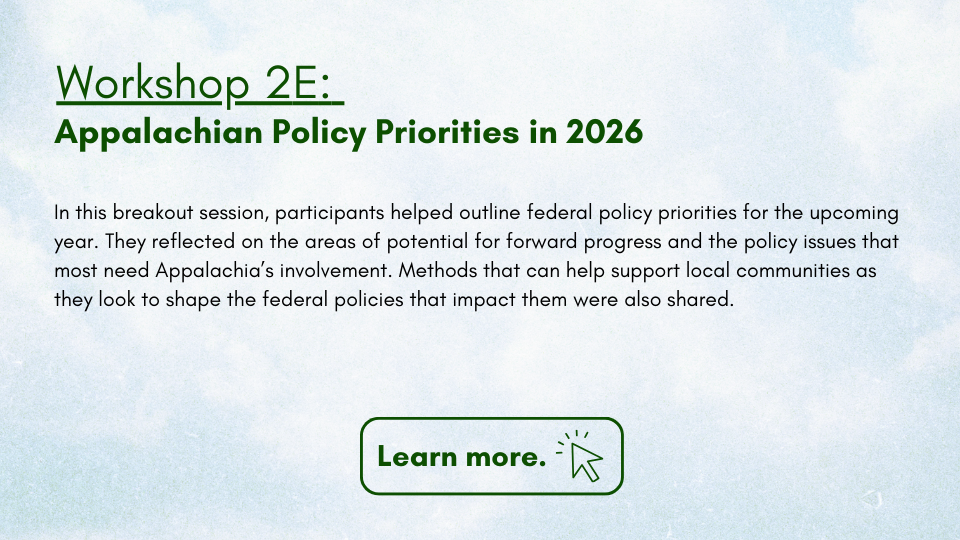
Policy
Workshop 2E

Day 2: What’s Next: Appalachian Response, Adaptation and Resilience
Panel 1: Moving the Appalachian Manufacturing Action Plan Forward
Panelists
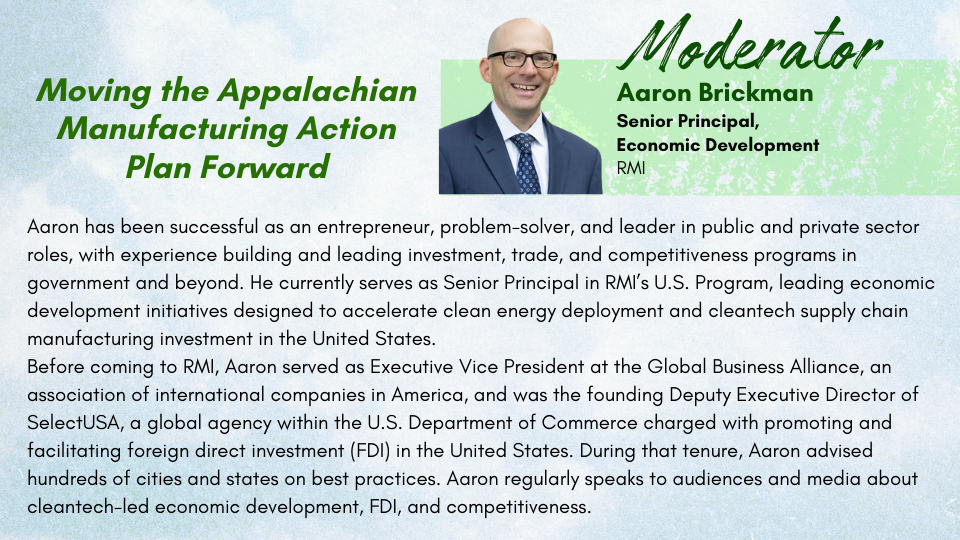
- Moderator: Aaron Brickman, Senior Principal of Economic Development, RMI
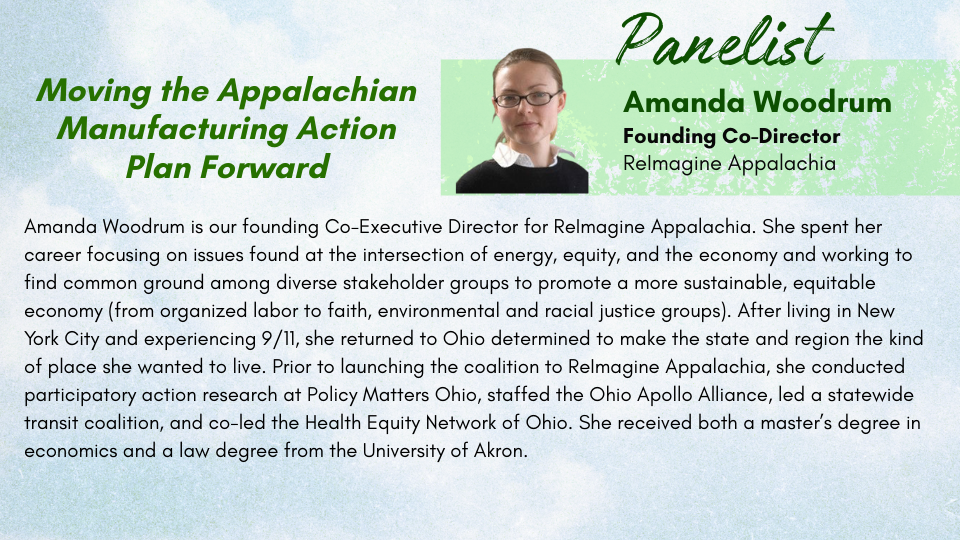
- Amanda Woodrum, Founding Co-Director, ReImagine Appalachia
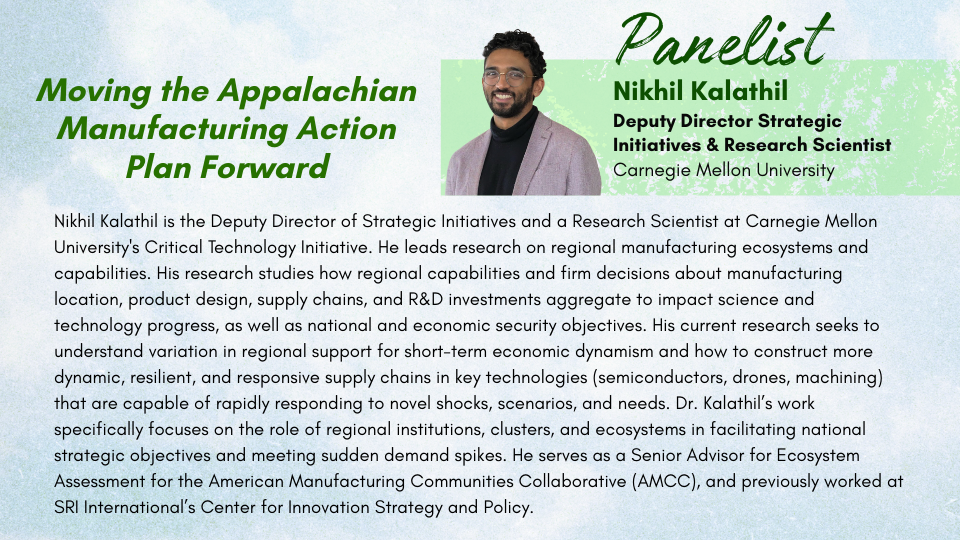
- Nikhil Kalathil, Deputy Director of Strategic Initiatives and a Research Scientist at Carnegie Mellon University’s Critical Technology Initiative
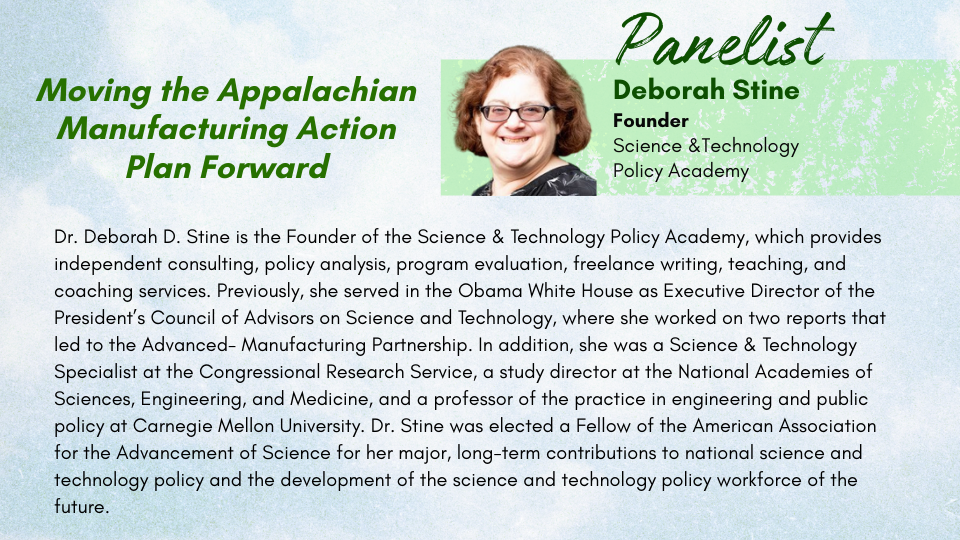
- Deborah Stine, Founder, Science & Technology Policy Academy
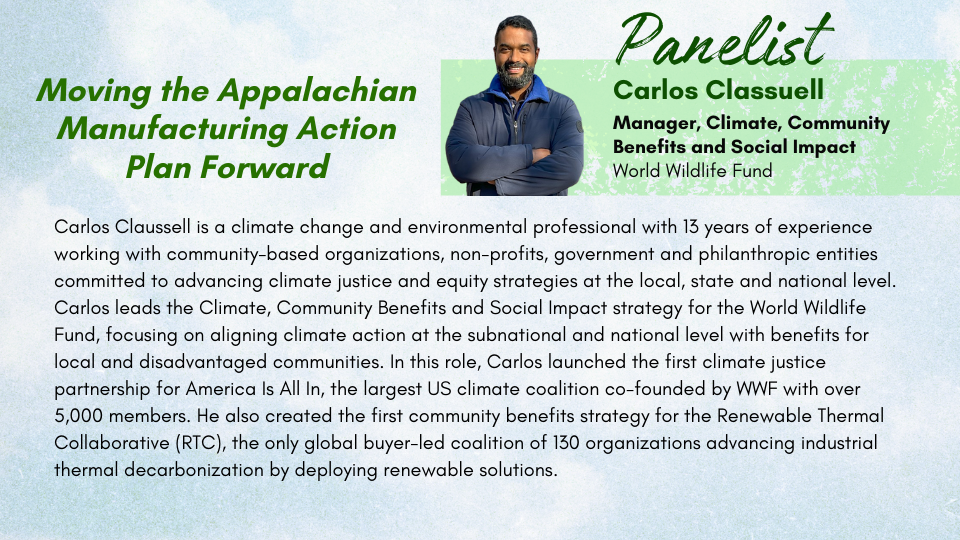
- Carlos Classuell, Manager, Climate, Community Benefits and Social Impact, World Wildlife Fund
Click and drag images to swipe through panelists (click images to pause motion)
Recording:
Aaron Brickman, Senior Principal of Economic Development, RMI, welcomed:
Nikhil Kalathil, Deputy Director of Strategic Initiatives and a Research Scientist at Carnegie Mellon University’s Critical Technology Initiative, and member of the American Manufacturing Communities Collaborative, provided some more insight into the Appalachian Manufacturing Action Plan (AMAP) and other tools. In order for manufacturing to continue to move forward, Kalathil explains how it requires a holistic approach that includes the whole of the supply.
It is challenging to get community members aligned. This is where Kalathil’s and ReImagine’s work comes in, developing tools to aid in ecosystem assessment using a variety of measurement pillars, finding common language and narrative for all stakeholders and community members, and identifying a collective strategy. Through this work, Kalathil has found that the Appalachian ecosystem has a potentially large network, but many folks were not aware of the related work of other groups. Kalathil is excited to continue working with ReImagine Appalachia on all these fronts.
Carlos Classuell, Manager of Climate, Community Benefits and Social Impact with the World Wildlife Fund, continued to share a perspective on industrial decarbonization. Industrial decarbonization is not just about reducing emissions, but it is also a core economic strategy that provides multiple essential benefits to the region. In this regard, sectors individually have very significant challenges, but if they come together to advance their economic vision, we can turn them into tangible benefits. Carlos posited that we often forget about industrial thermal decarbonization, which offers a driving approach to advance economic strategy forward, as 25% of the total energy used in the US comes from thermal energy. All in all, Classuell is looking to ensure that we can ensure industrial decarbonization in a way that also benefits workers and communities.
Debborah Stine, Founder of Science & Technology Policy Academy, followed up with an overview of upcoming projects, including a report on capturing waste heat from AI data centers for reuse in both the industrial sector as well as around the community. It’s important to co-locate data centers next to manufacturers, however, to make use of it. Another project that Stine has been working on for the past few months is a series on supply chain for Catalyst Connection, a manufacturing extension partnership based in Pittsburgh. Focusing on AI data centers in this supply chain reporting, Cline finds that these data centers are not very big employers when it comes to permanent jobs, but if we advocate to become a supply chain hub for data centers, we will be able to employ more people.
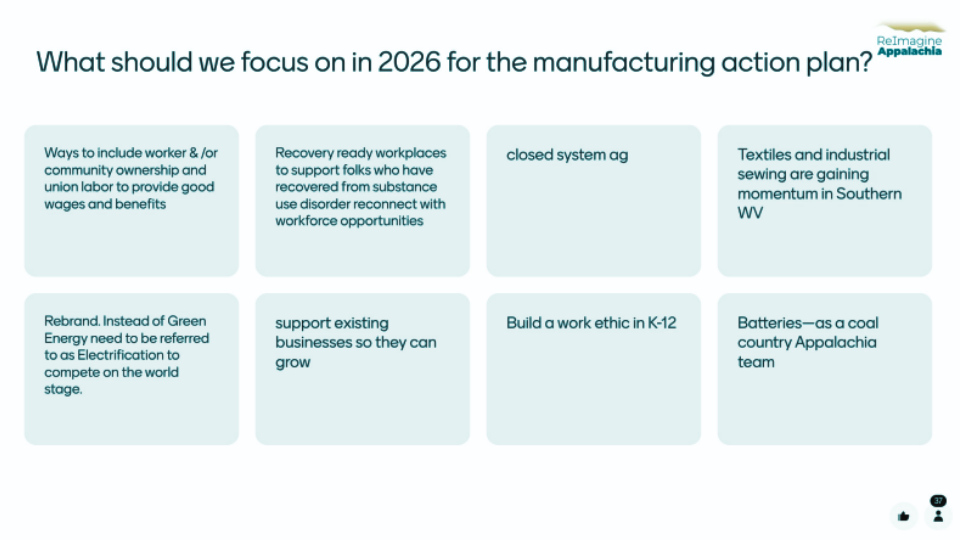
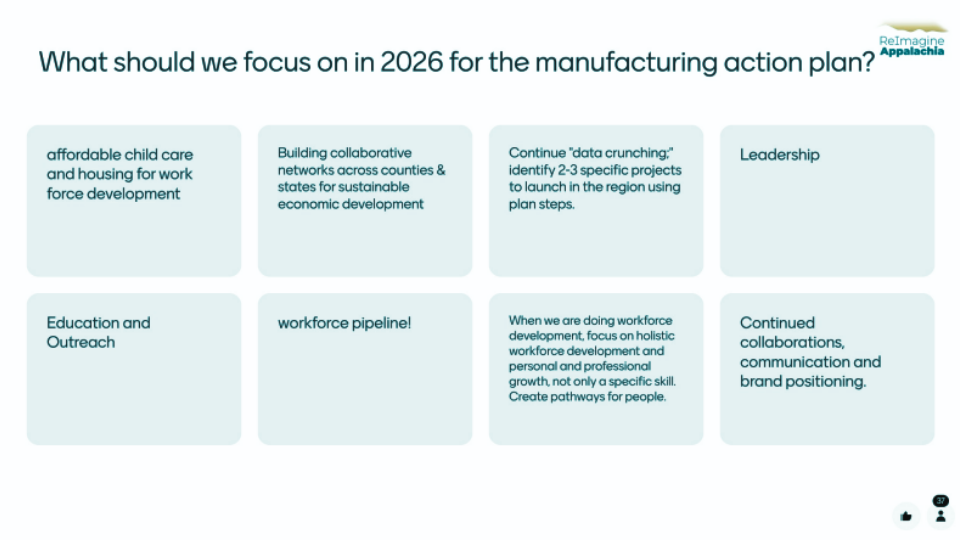
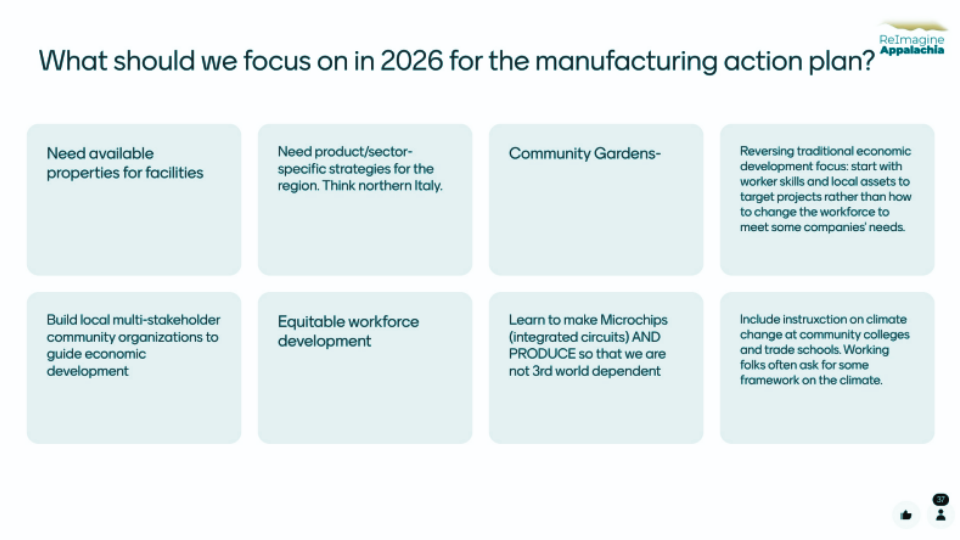
Attendees identified the following areas for action in 2026:
- There is untapped potential in increasing connections between university resources and community needs.
- Workforce development is a barrier for manufacturing clean technologies, and there is work that needs to be done with the educational systems to train these skills and reduce barriers that many people face that can prevent them from getting into this work, such as transportation. We need to evaluate manufacturing with a systems approach, including considerations of housing, transportation, childcare, etc. Replicating union apprenticeship and pre-apprenticeship models from the construction sector into the manufacturing sector can help.
- Workforce research can be coupled with supply chain efforts, thus building comprehensive efforts that look across many projects to address larger skill-related questions and issues while building industry-labor-community partnerships.
Appalachia has potential in industrial agriculture to grow alternatives to single use plastics (hemp, etc). It is important to support farmers’ efforts to enter the bioplastic supply chain and conserve agricultural lands.
Panel Mentimeter (audience participation) results


Facilitated Breakout Discussions Round 3
▼ Click the tabs below to view different workshops and access recordings
Finance
Workshop 3A
Labor
Workshop 3B
Arts & Culture
Workshop 3C
Manufacturing
Workshop 3D
Policy
Workshop 3E

Panel 2: Strategies for Appalachian response, adaptation and resilience to federal policy shifts
Panelists
- Moderator: Dana Kuhnline, Director of Programs, ReImagine Appalachia
- Sara Innamorato, Allegheny County Executive
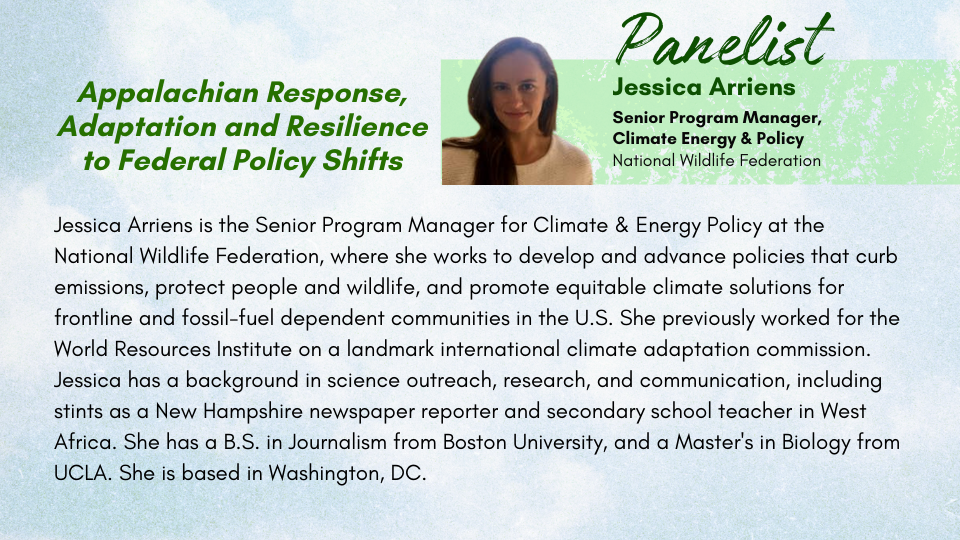
- Jessica Arriens, Senior Program Manager, Climate Energy & Policy, National Wildlife Federation
- Katelyn Walker Mooney, Senior Advisor, Laborers’ International Union of North America
- Katie Loudin, Deputy Director, WV Community Development Hub
Click and drag images to swipe through panelists (click images to pause motion)
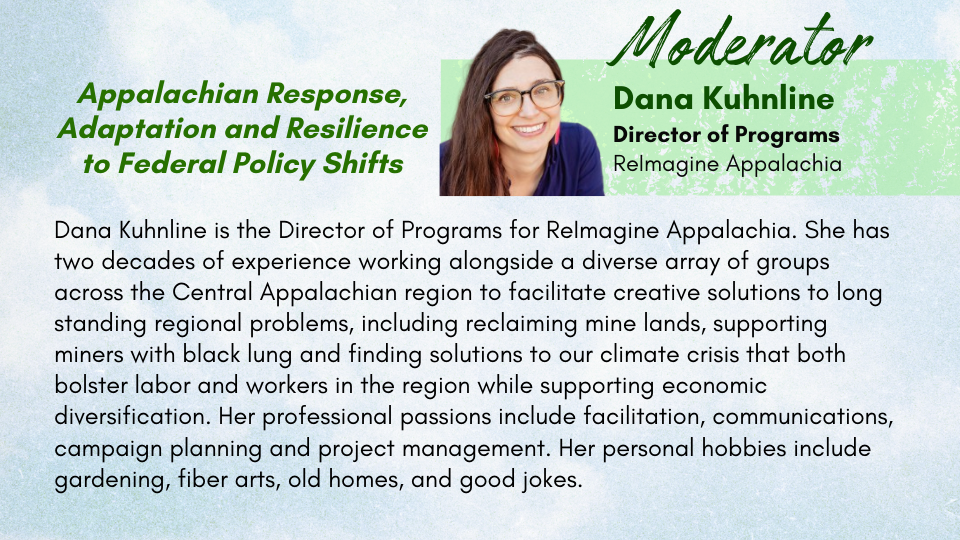
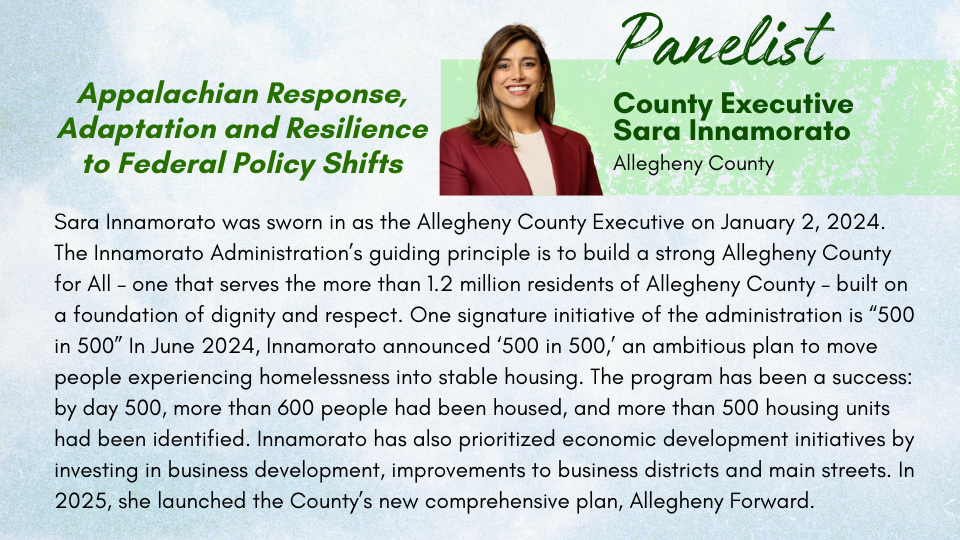
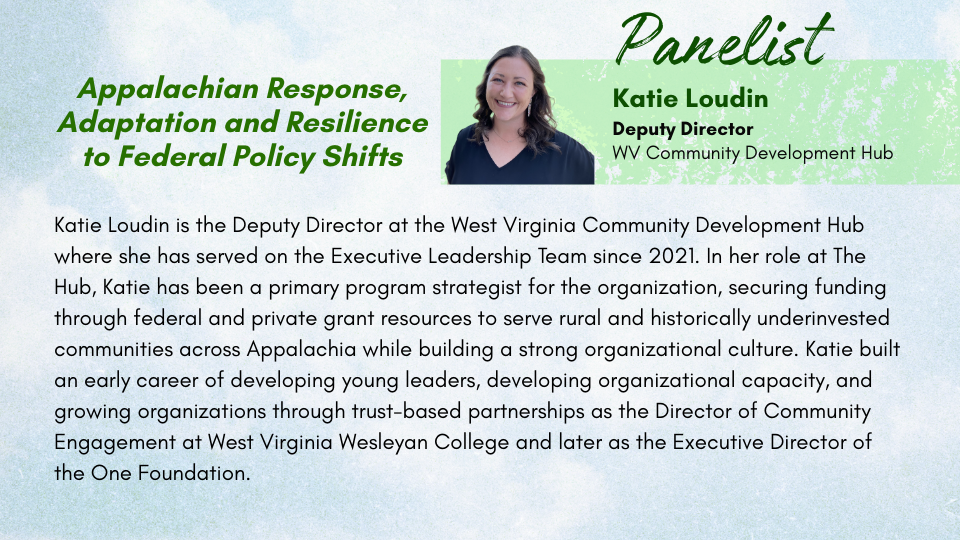
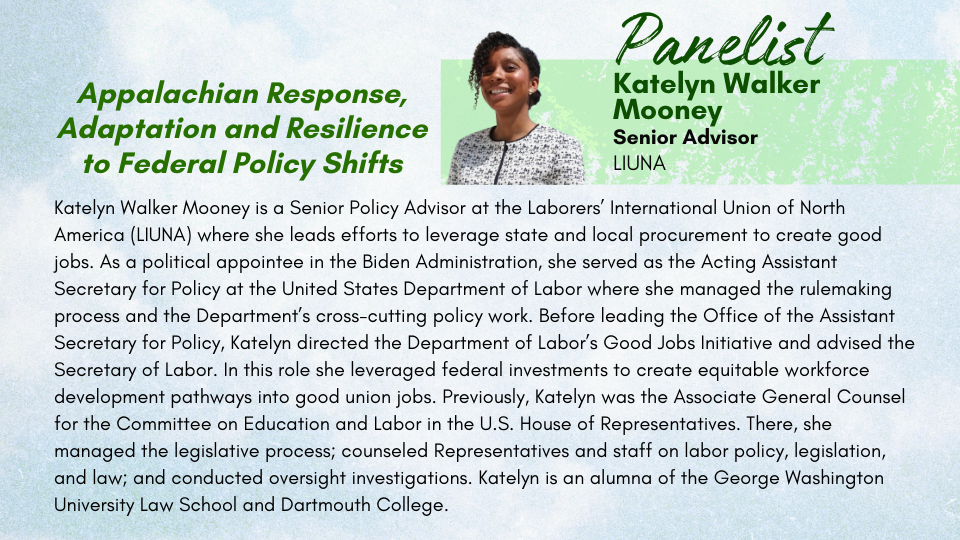
Panelists
Panel breakdown:
Allegheny County Executive Sara Innamorato began with a reminder of the importance of creating optimism. In these moments of uncertainty, drilling down to the community level can provide hope. Though there are a lot of setbacks with funding, it is about how we react to this moment that is important. It may be useful to shift towards regional, local, and state resources to fill federal funding gaps, and we must respond with pragmatism, creativity, and care for our neighbors. We also must connect across borders and work together instead of in isolation, as there is opportunity to share capacity and lessons learned between us. Executive Innamorato continued by stressing that we muststop fighting over crumbs and instead grow the pie for the region.
We must plan for volatility and expect to be flexible if funding sources shift, and let’s be certain our shared values hold. On a positive note, she has observed the strengthening of workforce pipelines which will outlast both administrations and funding cycles. To conclude, we need to keep in mind that human beings are the ones doing this work, and burnout is especially real in this sector. At the end of the day, sustainability is also about our workforce.
Katie Loudin, Deputy Director of the WV Community Development Hub stressed that we need to work to build capacity in rural communities to support resident-led community teams through community coaching, partnerships, networks, and coalitions. There is a hard year of work to do in 2026 with canceled/paused grants and changing programs: AmeriCorps programs in particular took a hard hit at the community capacity level in WV mid-year last year; funding feels much more competitive and has a faster pace than before; there is a large amount of institutional knowledge loss at the federal level with positions shifting with buyouts and retirements. In response, the Hub has pivoted and is excited about the new work they’re looking at. They’ve been involved with the Act Now Coalition and are interested in aiding disaster resilience plans, while also looking to take this model to new communities and refine it. We need to take the time now to slow down and lift up great work amongst all of the uncertainty and setbacks. Loudin stressed that it will be beneficial to focus on long-term approach and cross-organization impact mapping, as there are no longer just short-term grants. Overall, we may have to pivot strategies but the fundamental work of showing up for people has not and will not change.
Katelyn Walker Mooney, Senior Advisor of the Laborers’ International Union of North America (LiUNA), shifted to give some background on her organization before discussing the common ground they find with the worker-centered mission of the IRA and the BIL. For a lot of jobs, training/apprenticeship is necessary, but workforce development is demand-driven. This approach was built into federal climate resources under the Biden Administration (which has now gone away under the new administration). There are still new opportunities though. For instance, the Ohio River Valley Institute is working with the laborers to negotiate community benefits around solar investments in Kentucky. Investment is also still coming at a local level. And with this, state and local investment opportunities for clean energy can be used to raise work standards, with ordinances being able to be passed at local and county levels. At the end of the day, the goals that have brought us together can still be met but we need new approaches and ways of messaging to get there. Concluding, Walker Mooney encouraged us to not mourn, but organize.

Jessica Arriens with the National Wildlife Federation (NWF) started with an overview of her organization and their history with ReImagine Appalachia. The NWF is a nonpartisan, membership-based conservation group, with a mission to ensure that people and wildlife thrive in an ever-changing world. They have been a partner with RA since the beginning, and find pride in building coalitions with unlikely partners. This aspect of their organization has rendered them well prepared to meet our current moment, even though we face the strongest attack on climate issues and conservation in U.S. history. There have been efforts to deregulate manufacturing very recently with the EPA, and there is a rise of dis/misinformation on climate change and clean energy. Meeting this moment requires the ability to remain clear-eyed at the threats and challenges, though. And despite this uncertainty and challenge, there is still plenty of opportunity for progress. In the realm of flood/disaster resilience, it’s important to keep in mind thatfloods and disasters do not discriminate and are not partisan. Thus, flooding being a key issue for Appalachia presents an opportunity. In the renewable field, we can see that they are down but not out. Private investment into renewable energy continues and the cost of wind/solar has fallen this decade, showing promise. As for permit reform, permitting can take a long time but there is bipartisan interest to change this, providing opportunity. Overall, we need to continue to fight to ensure folks know what is going on anddouble down on long-term education and relationship building. Climate ambition is not a threat, but an opportunity, and Appalachia remains the center of all of these opportunities despite an uncertain future.