
April 16, 2026
In a society splintered by divisive issues, advocates must learn to win over persuadable audiences or keep to their silos. But is it possible to broaden the tent without watering down calls to action or being complicit in the face of poor ethics? A research-backed messaging framework called Race Class Narrative says that the answer is yes.
The 2026 Appalachia Matters Strategy Summit addresses a range of current challenges and methods for supporting a thriving Appalachia filled with sustainable opportunities for the future. An important tool for achieving our goals for the region is effective messaging. It’s no secret that we are living through particularly divisive times with a polarized political atmosphere. This environment can make it challenging to form strong coalitions built on shared common values, which may sadly be hidden by apparent political differences. Challenging discussions lie ahead, particularly with the rapid development of data centers sparking new discussions about the type of development we want to see in the region. It’s clear that unity and action towards shared values is needed now more than ever!
It is easy to feel lost within the current turbulent news cycle. Luckily, the first communications workshop at ReImagine Appalachia’s recent strategy summit offered some answers to address this pressing issue.
Introducing the Race Class Narrative
Ernie Britt from We Make the Future was kind enough to join our breakout session 1C to offer an introduction to the Race Class Narrative. We Make the Future provides communications and narrative-building support to mission-aligned organizations to advance a just, multiracial democracy – providing workshops and training. The Race Class Narrative (or RCN) and other race-forward, empirically backed messaging are at the bedrock of the organization’s theory of change. RCN is a messaging framework that can be used to build partnerships and accomplish collective action. It takes much of the guesswork out of messaging because it is a research-backed structure that can help groups and communities craft effective messaging to more easily connect with and mobilize their audiences.
This framework was developed around 2017 when organizers and activists were asking questions about how to address race and class within politics. In the face of intense scapegoating along race and class lines, the Race Class Narrative was formulated to combat this trend head-on and instead unite people of different backgrounds to fight for their shared values, win economic and racial justice policy solutions, and uplift the community as a whole.
Crafting Strategic Messaging = Defining the Audience
The first principle of the Race Class Narrative is to start by defining the audience. Ernie shared that while activists and those involved in the non-profit sector are quite good at speaking with each other, they make up less than 1% of voters. The remaining audiences he broke into three key groups: the base, the persuadables, and the opposition. Roughly twenty-five percent of voters are known as the base, voters who are already in agreement with our values, methods, and goals. The next group is the persuadables, around50% of voters who could be with or against our goals based largely on the messaging they are receiving — usually agreeing with whatever message is loudest and repeated most often. This is the key group that advocates need to reach through effective messaging! While it can be tempting to form counter arguments to the opposition, the last ~25% of voters who are against our goals, this is not productive because there is very little we can say that can change their mind (unlike the persuadables). When it comes to the opposition, messaging should aim to be strong enough to neutralize the dissenting arguments without directly engaging in back and forth arguments.
The Message!
In terms of the content of the messaging, extensive research has been done to identify the best way to connect with audiences and inspire positive action. The Race Class Narrative is built around three core elements.
-Cross-racial solidarity: When we evoke solidarity across race, class, gender, and more, we push back against the divide-and-conquer tactics of our opposition and remind our audiences that if we work together across our differences – as neighbors – we can create thriving communities where everyone belongs, no exceptions.
-Government for all: When we evoke government for all, we remind our audiences that our government should work for all of us, and not just the wealthiest few. -Shared prosperity and racial justice: When we evoke racial justice and shared prosperity, we remind our audiences that our opposition has long sowed fear and resentment across race, class, and gender for their own gain, and that, when we continue the work of freedom and opportunity for all – whether you are Black, white or brown, transgender or not, native or newcomer — we all benefit.
Everyone deserves basic rights and qualities of life, and there is enough for all of us.
There is so much research out there about the benefits of equity and uplifting disadvantaged communities, and it may seem like a good idea to turn to this data in our comms work. While facts and statistics are important, audiences actually connect more with rallying around shared values and a call to action than diving into too many stats and studies all at once.
Broadly, the Race Class Narrative recommends taking the following approach.
Identify shared values-> discuss the problem and who is behind it-> issue a collective call to action
The Framework
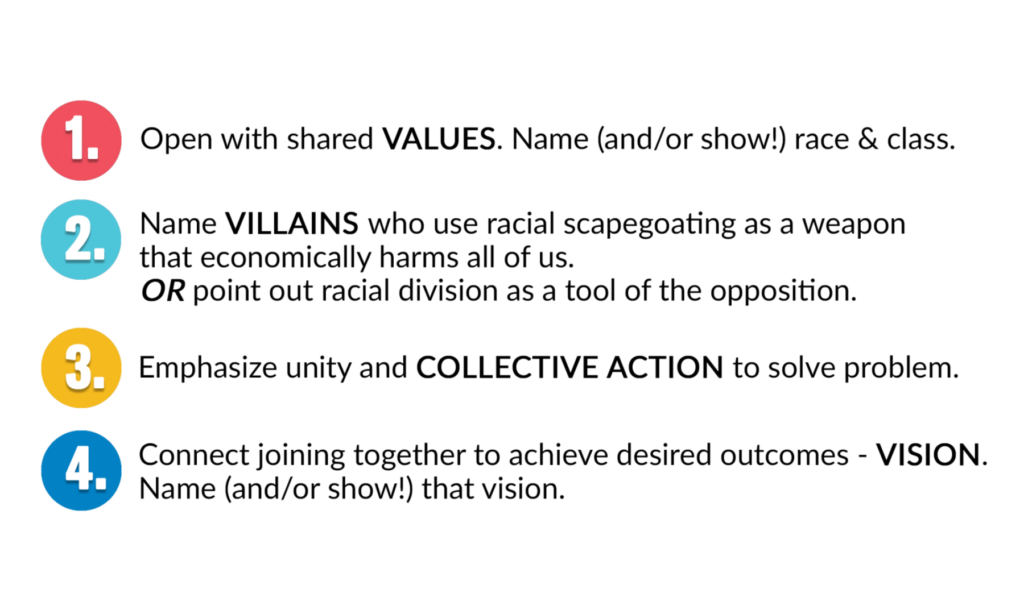
Let’s run through the four specific steps within the full Race Class Narrative framework with an example to see how we can use it to craft a compelling message.
Open with values
The first statement should establish shared values that many people would support across race and class.
No matter what we look like or how much money we make, we all want to live in places where we can afford to raise a family, and we want our kids to grow up with the freedom to drink clean water, breathe safe air, and live in healthy communities.
Naming villains or pointing out division as a tool of the opposition
Naming the villain is not about name calling, but rather calling out the actions of individuals who are jeopardizing the shared values. Really, this step is about pointing out that these problems are created by humans, and thus, we have the power to change the systems too. Instead of facing an anonymous force of opposition, this step helps identify clear places for change and the specific actions that will achieve the goal. Let’s look at the example of AI data centers in Appalachian communities. Whether our goal is to ensure these facilities develop responsibly and provide community benefits, or if we seek to halt development if they can demonstrate their benefit to communities, here are some messaging examples in alignment with the race class narrative.
EXAMPLE:
Ex, 1: Across races and places, we all want the same things — steady jobs that let us provide for our families, safe communities, and the pride of building something lasting for our kids. But when it comes to massive data centers, the reality doesn’t always match the hype. We’ve heard big promises before about jobs and wages — from coal, fracking, and plastics. Yet time and time again, wealthy corporations pay off politicians to raid public funds for kickbacks to their pet projects, but once the subsidy is gone, often these companies are too.
The rich CEOs walk away richer, and we’re left with the empty facilities and lay-offs.
Ex, 2: We’re fed up with get-rich-quick schemes that benefit the few over the rest of us. That’s why we’re coming together to fight for the future we want: jobs that pay us what we’re worth and communities where we can put down roots for the long haul, for all of us.
Emphasize unity and collective action to solve the problem
Here, we discuss how joining together will help achieve desired outcomes. Try using a “we have, we can, we will” structure to highlight past victories as a means of inspiring present action for future wins.
Ex: By joining together and organizing, a number of communities have already managed to re-negotiate the terms of these developments or halt them altogether if satisfactory conditions could not be met. We must continue to do this work to ensure new development is done responsibly in a way that considers the long-term prosperity of our communities.
How appealing to the five senses is an effective tool for getting people on board with a shared vision
This is where idea turns to action! It helps to speak confidently about the inevitability of success (not “if we win” but when we win!) to help people imagine what it will be like when they achieve the goal. This step is about helping people expand their view of what is possible so they dare to dream of more and seek next actionable steps. End the message with your specific call to action once the vision is clarified.
When we stand up for our communities, it looks like ensuring communities where everyone can earn a good living and build a good life and can support their family. It looks like the community coming together to say that our history, our land and natural resources deserve to be protected from reckless development. And when we win it feels like we have each other’s back, it sounds like kids playing freely outside, and it looks like the type of place we want to see in the future. We need your help in this mission to safeguard our community. Please join us in [insert specific call to action].
Final Thoughts
Cynicism is one of the biggest obstacles that prevents communities from taking action. The Race Class Narrative reframes what is possible to overcome this crippling sense of cynicism. More than attracting attention online, this framework for messaging empowers audiences to take real action towards protecting their shared values and making their communities a better place. Ernie shared that this is about building narrative power, telling persuasive stories that shift the cultural common sense into alignment with our values. Together we can define our vision for the future, and through effective messaging, bring our dreams into reality!