
Thursday, November 19, 2026 11:00 AM – 12:00 PM ET
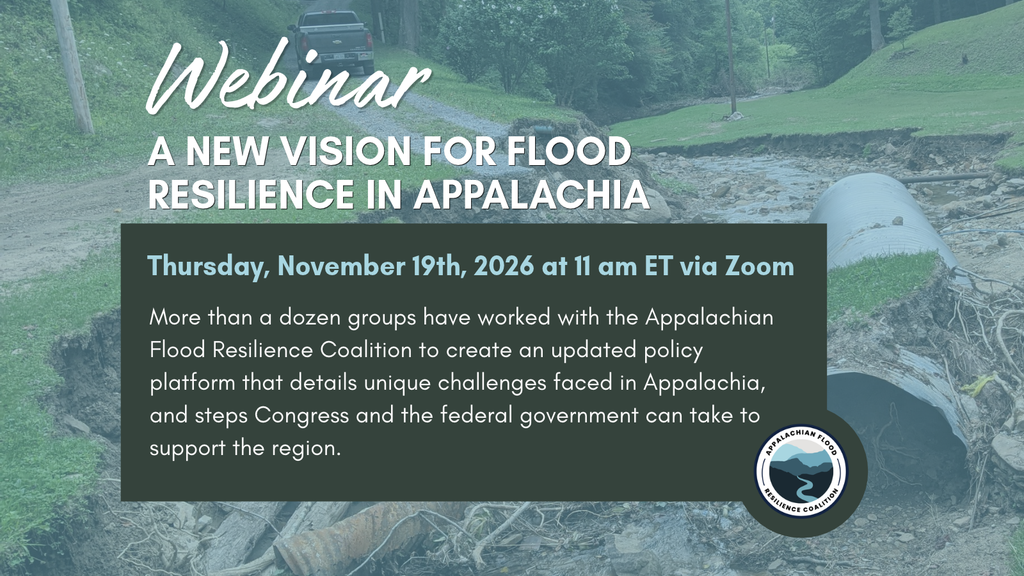
Thursday, November 19, 2026 11:00 AM – 12:00 PM ET – In November 2025, organizations across seven states, joined together to launch the Appalachian Flood Resilience Coalition to drive regional collaboration and advocacy in support of policy change and investment needed to create a resilient Appalachia.
One year later, the coalition will release an updated platform titled: “Flood Resilience in Appalachia.”
This platform is directed, in part, at the 120th Congress and details unique challenges faced in Appalachia, as well as concrete recommendations for steps Congress and the federal government can take to support the region.
The four policy pillars in the platform are:
- Increasing local and state capacity to respond and recover
- Relieving the recovery and mitigation burden for low-income households
- Improving flood mapping and data inputs
- Investing in nature-based hazard mitigation
This platform is an update to the 2024 platform. That platform was informed by learnings after the devastating July 2022 floods in Eastern Kentucky, from surveys from local officials across the Appalachian region, and with support from researchers and community advocates.
Since the 2024 platform was released, Appalachia has experienced a series of destructive flooding events, including Hurricane Helene (September 2024), widespread flooding in Kentucky and West Virginia (February 2025), the Father’s Day floods in West Virginia (June 2025), and major summer floods across Kentucky, Ohio, and West Virginia (August 2026). These events reinforce the urgency to build a more resilient Appalachia.
Hurricane Helene, in particular, demonstrated the depth of the challenge facing rural, mountainous communities in the region. Catastrophic flooding in parts of central and southern Appalachia, particularly in western North Carolina, destroyed homes and public infrastructure, isolated communities, and placed extraordinary demands on local governments and local emergency response agencies. The storm underscored how Appalachia’s geography, aging infrastructure, local capacity, and patterns of historical development along streams and rivers can exacerbate the consequences of extreme rainfall events. For many rural communities, the disaster did not end when the waters receded; long-term recovery continues even now, as households, businesses, local governments, community organizations, and others navigate the complex federal recovery programs necessary to rebuild.
At this event, speakers will detail findings on the state of disaster resilience in the region, particular weaknesses that must be addressed, and share recommendations for the incoming 120th Congress.