
September 10, 2026
Written by Gavin Loyd
In Spring, Carnegie Mellon University hosted its annual Energy Week; energy leaders from across the country met to discuss the most pressing issues facing the energy sector, with an emphasis on strategies to sustainably decarbonize the U.S. grid.
Not surprisingly, a lot of these conversations focused on the particular pressures on energy prices created by data center buildout.
While discussions among energy specialists may not capture everyone’s attention, the majority of us are acutely aware of our monthly electricity bill. Affordability is increasingly a top public issue.
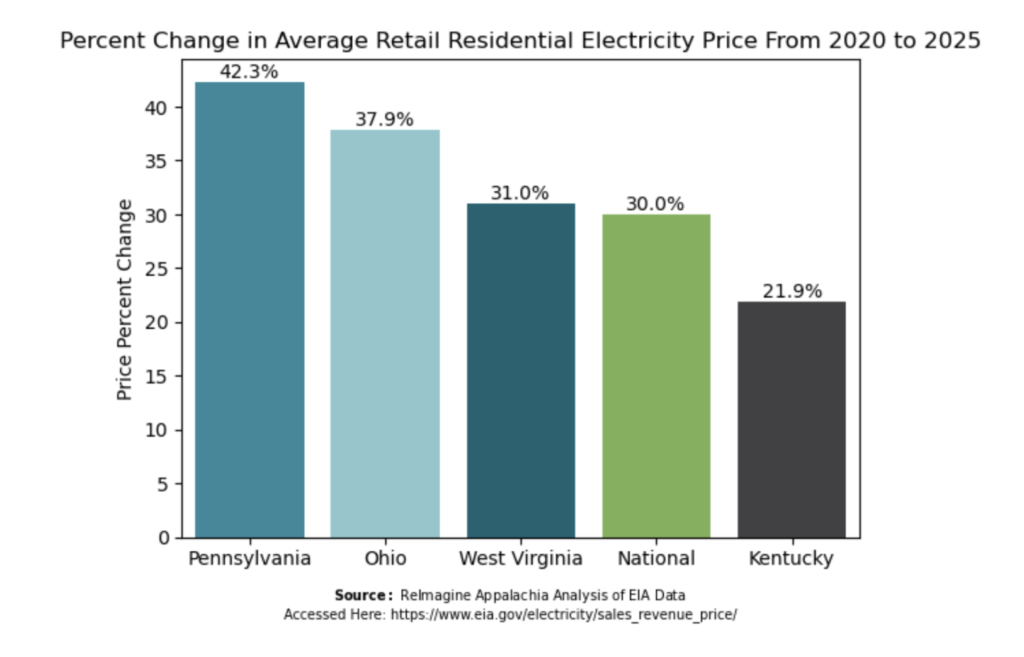
From 2020 to 2025, average yearly residential electricity rates in the Ohio River Valley increased significantly. In our four-state region of Kentucky, Ohio, Pennsylvania and West Virginia residential electricity prices rose between 21.9% in Kentucky to 42.3% in Pennsylvania. Three out of four states, Pennsylvania (42.3%), Ohio (37.9%), and West Virginia (31%), saw a five-year increase that exceeded the national price hike of 30%.
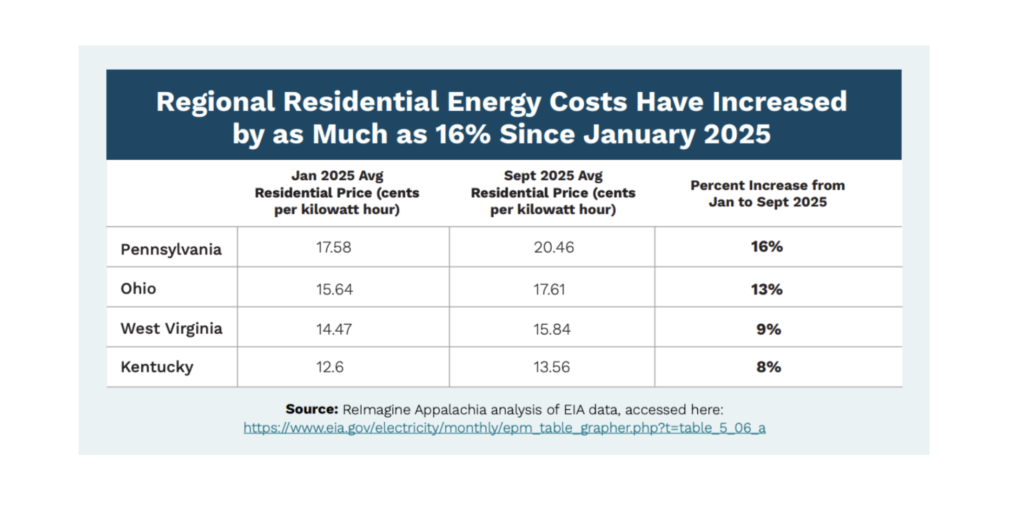
ReImagine’s own analysis, published late last year, found that energy costs rose across all four states between January and September 2025, with increases ranging from 8% to 16%.
This steep rise in electricity bills means that some people are risking their health through insufficient heating/cooling of their homes, and are forced to choose between paying these bills and buying food and medicine. The affordability crisis is at the front of everyone’s minds. In light of Energy Week and the discussions there, including a panel on affordability, I’d like to explore some of the affordability work being done.
Initiatives for Affordability
Targeted Bill Relief
Before we get into the impacts of data centers, let’s look at some of the immediate avenues available to lower residential electric bills.
Continuous access to electricity is a necessity to stay at healthy temperatures, cook, use the internet, and more. Low-income households do not have the flexibility to eliminate their electricity bills absent full disconnection. If you want to lower bills with more efficient appliances, it costs money upfront that a lot of us can’t afford, especially when compared to rising fixed energy costs.
Due in particular to cuts in energy efficiency programs by the Trump administration, improving a house’s insulation, installing solar panels, or upgrading to energy-efficient heating and cooling systems is financially out of reach for most low-income families.
Researchers and consumer advocates have identified that targeted programs and funds to these households can help them pay their immediate bills and reduce individual energy poverty. These approaches tend to fall into two categories with low-income requirements.
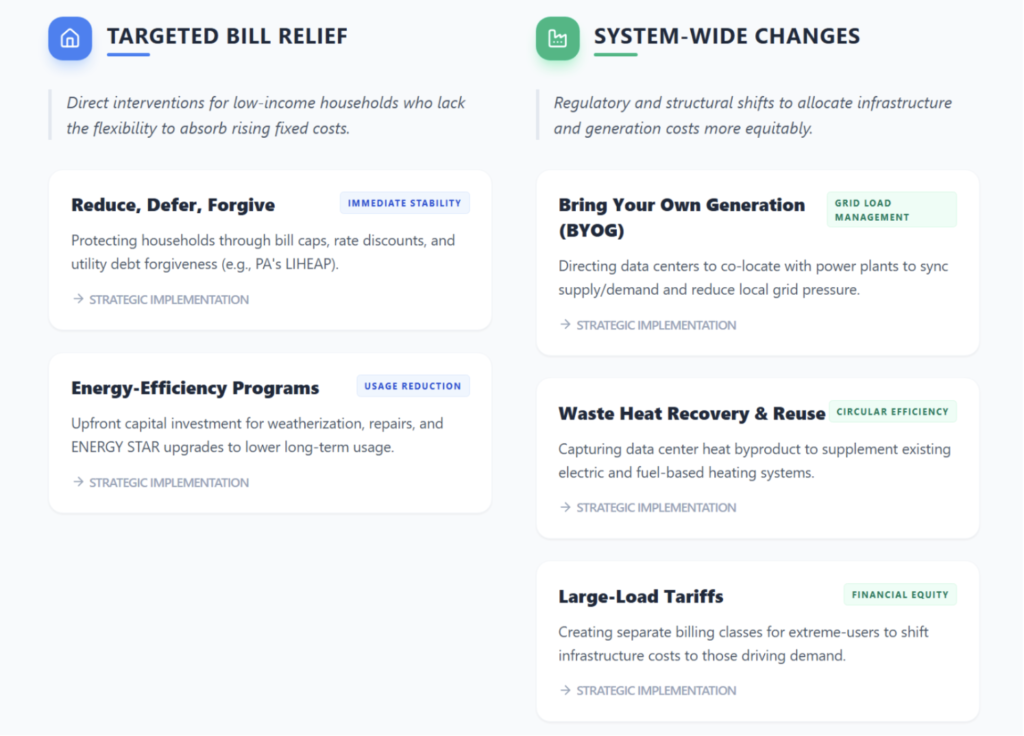
- Reduce, Defer, Forgive: Many programs reduce the total burden on consumers’ electricity bill by capping bills, discounting electricity rates, or forgiving portions of utility debt. The federal Low Income Home Energy Assistance Program (LIHEAP) provides so-called block grants to each state which, in turn, uses the funds to run its own version of home energy assistance. For example, Pennsylvania’s Low Income Home Energy Assistance Program (LIHEAP) provides cash grants directly applied to a low-income applicant’s utility provider to offset costs. These programs can be temporary or long-term with the goal of protecting households and giving them the chance to get on a stable bill schedule.
- Energy-Efficiency programs: Utilities, public utility commissions, and various governments can invest the upfront capital to pay for energy-efficient upgrades. Weatherization, repairs, ENERGY STAR products, are all viable options that reduce households’ energy bills.
Data Centers’ Impacts on Utility Bills (Cost Allocation and System-Wide Changes)
An electricity bill is dependent on more than the individual usage of appliances. Things like the cost of local utilities acting to build new transmission and distribution lines can make up 40% of your bill. Lagging new power generation to meet rising demand, for instance from data centers, also raises the cost of your electricity.
Regulators like the Federal Energy Regulatory Commission (FERC) and state public utility commissions are exploring ways to allocate costs for things like new transmission lines that are fair for consumers.
One big reason for increased energy infrastructure costs is new data centers. Residential consumers are worried about data centers’ increasing electricity demand, fearing that utilities will pass on the cost of associated infrastructure buildouts.
Right now, the details of this allocation process are being hammered out across competing interests. Some AI companies are going as far as to self-select into pledges that they will pay for their impact on the grid. How the follow-through of such cost allocation plans and AI industry pledges will be guaranteed and measured is unclear.
Zooming in on data centers, the most common paths to reduce costs to utilities (and therefore consumers like you) being discussed include:
- Bring Your Own Clean Energy (BeYONCE): FERC has directed Appalachia’s grid operator PJM to establish transparent rules for data centers interested in “co-locating” or building next to their own power plants. Rules that identify official approval mechanisms can allow data centers to build small power-generating facilities that directly serve their electricity needs, rather than selling power into the broader market. Traditionally, power generators and data centers are planned and built separately with different developers and very rarely are considered as “built together.” Making it easier for a data center to build their own energy, such as a solar farm, could reduce a data center’s demand on its local grid. A growing movement calling for BeYONCE or Bring Your Own New Clean Energy demands that data centers offset their power use by deploying clean energy like solar specifically.
- Waste Heat Recovery & Reuse: Data centers produce heat as a byproduct of operations. A recent ReImagine report explains how this heat can be used to reduce electricity bills by either building new data centers that include waste heat systems, or by supplementing existing electric and fuel-based heating systems already in use. Regulatory and fiscal incentives can support the buildout of appropriate infrastructure that utilizes waste heat recovery and reuse. With such a system in place, data centers can decrease their energy demand in an area.
- Large-Load Tariffs: Tariffs in electricity markets are the regulatory and financial structures for electricity service determining how electricity is priced and delivered. Some affordability advocates want to create separate classes for “large loads” or extreme-users of electricity, like data centers, and distinguish them from residential rate payers. These new classes would make it easier to design billing structures that allocate more of the costs of new generation and transmission to these extreme-users of electricity who are leading the increase in prices and can bear more of the cost.
Increasing Clean Energy Supply Over Time
A practical way to reduce electricity bills is to ensure an abundant supply of electricity. As noted above, electricity prices reflect the availability of power generation. Insufficient power generation capacity means increased bills as prices reflect that scarcity.
Luckily, clean energy resources like solar and wind are both the fastest and cheapest power generation sources to build in the United States, reflecting decades of cost reductions and improvements in the technologies. In combination with battery storage systems, they contribute to a more affordable and reliable electric grid.
However, recent policy shifts and federal obstruction make it more difficult to build renewable energy sources, leading to rising electricity costs. This underscores the importance of returning to a well-designed clean energy policy approach that encourages and enables solar and wind deployment. More wind and solar mean cheaper electricity bills.
There are various state-level approaches to solving this problem; today, we’ll focus on the federal level. The Energy Bills Relief Act is currently being discussed as one opportunity to fix recent policy mistakes and support energy affordability. In terms of clean energy, the bill:
- Restores Tax Credits: The “One Big Beautiful Bill Act” rolled back tax credits for solar and wind. The bill would bring back those credits to encourage the deployment of these energy sources.
- Prevents Abuse of Federal Permitting: Recent federal permitting has discriminated against wind and solar farms in favor of fossil fuel plants, harming investment in clean energy. The law would force the federal government to hold clean energy to the same standards it holds oil, gas, or coal projects to when evaluating permitting decisions.
- Expedites the Interconnection Queue: A major obstacle across the electricity industry to getting new power online is the interconnection queue. Every major generating facility needs to have its expected impact on the grid studied and approved before it can produce power. However, that process can take up to five years just to be approved, creating significant delays in meeting electricity demand. The bill mandates automation and modernization efforts to speed up the process.
Energy Affordability is Possible
The energy affordability crisis is an avoidable crisis in America. While many Americans are facing rising costs in their utility bills, it does not have to be that way. Advocates, experts, and regulators across the country are innovating solutions to the affordability crisis and we have an opportunity to get it right. We can:
- Support low-income families with targeted assistance in the short-term.
- Design rules for data centers that encourage them to pay their own way, rather than offloading costs onto our communities.
- Pass smart legislation, such as the Energy Bills Relief Act, to bring back clean energy momentum and meet our energy needs going forward.
For further information on this topic, please see other ReImagine Appalachia work, such as our article “Is Responsible Data Center Development Possible?,” which is part of our series “Build a 21st Century Sustainable Appalachia.”