
May 8, 2026
The Environmental Protection Agency (EPA) is spreading false or misleading statements about dangerous greenhouse gases to justify its recent refusal to regulate them. Through a rollout of precarious legal interpretations, alternative science, and cherry-picked consumer data, EPA has built a large body of counter-information to support actions that could spur increased community devastation from climate change and ultimately drive up vehicle-related costs for consumers. This three-part blog series aims to demystify EPA’s convoluted reasoning for terminating the Endangerment Finding and help readers better understand:
- PART 1: What the Endangerment Finding is and why it matters.
- PART 1: The legal arguments that the Trump administration’s EPA is making to rescind the finding, and why they are weak.
- PART 2: The scientific rationale behind the decision and why the majority of the scientific community rejects it.
- PART 3: The promised economic benefits that EPA claims rescission will spark, and why it will likely bring the opposite.

The 2009 Endangerment Finding is a work comprising hundreds of pages. This includes the final rule document, the technical support document, and the response to public comment document. It’s a comprehensive assessment of peer-reviewed scientific evidence, including divergent viewpoints drawing upon the deep expertise of hundreds of scientists and experts from groups like the U.S. Global Change Research Program, the Intergovernmental Panel on Climate Change, and the National Academy of Scientists, and The National Research Council. The conclusions presented in the finding are the result of thousands of studies. The new Trump-appointed Environmental Protection Agency (EPA) Administrator Lee Zeldin’s apparent strategy for building skepticism around the finding is to point to alleged “inconsistencies” in any one of those studies and use oversimplified logic to portray the entire report as being riddled with fallacies. He often references these “fallacies” when explaining why he rescinded the finding. When interviewed in a two to five-minute news segment, he often appears successful at throwing off journalists who haven’t committed the finer points of the finding to memory. One of his most perplexing claims is that none of the six greenhouse gases examined in the Endangerment Finding were studied individually. “What was done in 2009 is that they didn’t analyze each of these individual greenhouse gas emissions individually, and they didn’t just study and utilize greenhouse gas emissions from vehicles. They added additional greenhouse gases on top of it, even if they weren’t emitted from vehicles and trucks,” Lee Zeldin told CBS News in February 2026.

The notion that the Obama-era EPA and its collaborators in the scientific community did not analyze the six greenhouse gases (GHG) listed in the Endangerment Finding individually is perhaps Zeldin’s biggest science-themed talking point when he defends rescission of the finding. He says that because the finding examines the collective impact of six GHGs, but puts a priority on curbing Methane and CO2 (which are emitted from vehicles) that it is just scapegoating vehicles for a phenomenon that is actually much more far-reaching. So is it true? And if the Obama-era EPA did just bunch different GHGs together and made logical leaps that CO2 was harmful, wouldn’t that force a gap in the finding’s credibility? The simple fact is that the claim is deeply misleading at best and outright false at worst. The Endangerment Finding exhaustively examines each of the greenhouse gases, including how long they linger in the atmosphere and how they are impacted by atmospheric phenomena (For example, see page 28 of the Technical Support Document. See also pages six through seven for a breakdown of how prominent each gas is in the atmosphere). Zeldin is right only in the sense that the EPA didn’t publish six endangerment findings, one for each of the greenhouse gases. But doing so would have been impractical and scientifically unnecessary.
The atmospheric properties of each of the six gases are well documented. Namely, that they trap heat and hang in the air for a long time. Furthermore, different greenhouse gases intermix when in the atmosphere. While it is true that individual gases can produce a “fingerprint” that helps scientists study them, it is not possible to observe just one gas’s impacts on climate change independent of all others. It is unclear what kind of study would satisfy Zeldin’s skepticism. If he requires that climate scientists study how just one gas impacts global warming by itself, it seems that would require a lab-proofing of the sky, clearing all but one type of gas from the atmosphere for study. If scientists were capable of that, there likely wouldn’t be a climate crisis in the first place. That being said, the question of why the EPA has singled out CO2 is a reasonable one, and the answer is simple. The Endangerment Finding focuses on vehicles and power plants because those are the biggest emitters of CO2, and CO2 accounts for more than 70 percent of greenhouse gas emissions. CO2 also remains in the atmosphere for longer than any of the six gases, lasting anywhere from 30 years to thousands of years. For that reason, it only makes sense to put controls on CO2.
The scientific rationale for rescission continued
Zeldin’s next go-to line of argument is that the scientific community has failed to examine the potential benefits of greenhouse gases. For example, global warming could potentially lengthen growing seasons and increase food supplies. In fact, on the day the EPA announced its reevaluation of the Endangerment Finding, the Department of Energy (DOE), headed by Trump appointee Chris Wright, released its alternative take on greenhouse gases and climate science. The paper, titled: A Critical Review of Impacts of Greenhouse Gas Emissions on the U.S. Climate, examines the potential benefits of global climate change, making statements like: “The growing amount of CO2 in the atmosphere directly influences the earth system by promoting plant growth (global greening), thereby enhancing agricultural yields, and by neutralizing ocean alkalinity.” It says on page 12 of the report.
The DOE report, however, goes contrary to the majority of scientific opinion. And the report has been criticized for cherry picking, misleading, and misrepresenting the data. Take, for example, its statements on ocean acidification or alkalinity (alkalinity meaning in this case the ocean’s ability to neutralize acids. The term is also used interchangeably with the term pH). The complex language that the DOE uses in the following quote will be explained:

“CO2 absorption in seawater makes the oceans less alkaline. The recent decline in pH is within the range of natural variability on millennial time scales. Most ocean life evolved when the oceans were mildly acidic. Decreasing pH might adversely affect corals, although the Australian Great Barrier Reef has shown considerable growth in recent years.” It says on page 13 of the DOE report.
There are several issues within this paragraph. First, claiming that pH levels are “within the natural variability on millennial time scales” (meaning that ocean acidification has reached current acidity levels naturally within the past one thousand years) contradicts the overwhelming majority of scientific findings. Research by the Intergovernmental Panel on Climate Change (IPCC), which is the United Nations body for assessing the science related to climate change, reports that “There is very high confidence that present-day surface pH values are unprecedented for at least 26,000 years…” it says on page 76 of the report.
Furthermore, while it is true that the Australian Great Barrier Reef saw a historic recovery in 2022, in 2024 the reef relapsed, experiencing the largest coral bleaching event ever recorded. The event was officially documented as the fifth mass bleaching event since 2016.
On the potential benefits of climate change
The Department of Energy’s report attempts to create a counter narrative to mainstream science and show how climate change’s impacts can range from positive to inconclusive. Administrator Zeldin has repeatedly condemned the Endangerment Finding for failing to explore the positives of rising global temperatures. However, the Endangerment Finding carefully evaluated the potential benefits of global warming. See examples below from the technical support document.
- “Expected positive benefits of warming include improved traffic safety due to fewer days with snow on the ground and decreased heating oil demand.” – Page 145
- “Studies in temperate areas (which would include large portions of the United States) have shown that climate change is projected to bring some benefits, such as fewer deaths from cold exposure.” – Page 82
- “…navigational benefits from climate change exist as well. For example, the navigation season for the North Sea Route is projected to increase from the current 20 to 30 days per year to 90 to 100 days by 2080.” – Page 116
Original public domain image from Wikimedia Commons
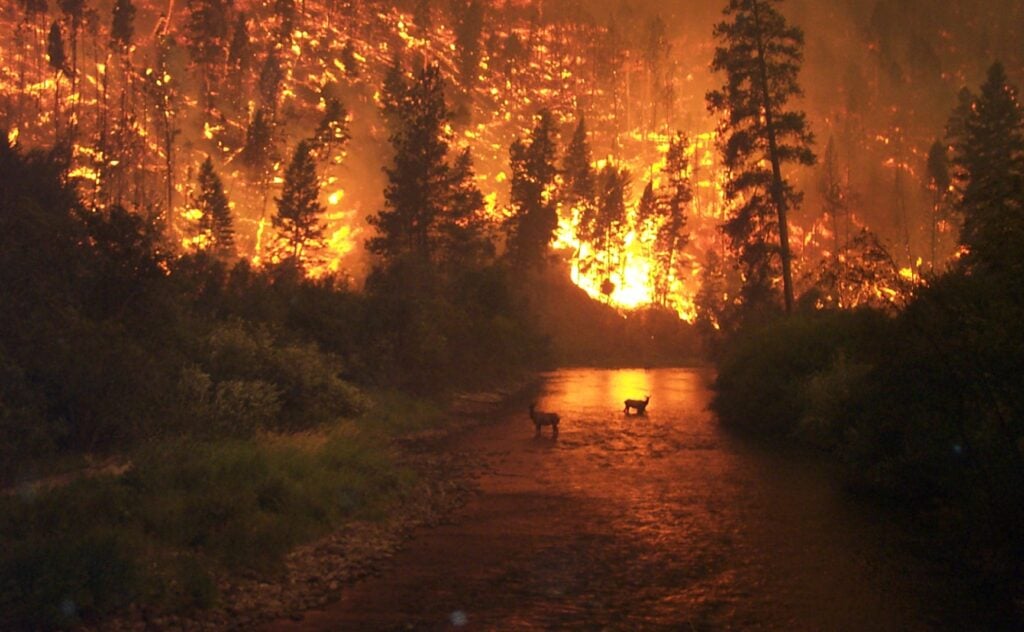
These are just a few of the benefits that the endangerment finding lists. The problem, however, is that most of the benefits are offset by harms that are only becoming will only become more extreme, deadly, and unpredictable with time. The same global warming that extends growing seasons for cooler or more temperate places is causing heat stress, droughts, and wildfires in hotter, drier regions. Extreme heat, for example, is now the deadliest form of extreme weather; in most years, and in America alone, it kills more people than floods, fires, and hurricanes combined. Another issue the findings note is the increased intensity, frequency, and severity of natural disasters that accompany a warming climate. As weather phenomena become more unpredictable, banking on the short- term benefits of climate change is not a sustainable plan.
“While there are likely to be some benefits and opportunities in the early stages of warming, negative impacts are projected to dominate as climate continues to change.” – Page 129 of the Endangerment Finding’s technical support document.
Children’s video on how greenhouse gases work:
Conclusion
At this point, we are dragging the greenhouse gas conversation back to what it was in the 90s. The only difference is that instead of outright climate denial, disparagers of climate science in 2026 say that while climate change may be real, it’s too much of an uncertain, messy, and complicated subject to take decisive action on – especially if it would impact the fossil fuel industry. For example, it says on page eight of the DOE’s alternative science report: “Climate change is real, and it deserves attention. But it is not the greatest threat facing humanity. That distinction belongs to global energy poverty.” – U.S. Energy Secretary Christopher Wright.
But is it true that the choice comes down to prioritizing environmental or prioritizing energy efficiency & economic growth? As the next blog in this series will show, not only are the two not mutually exclusive, but if we fail to ensure sustainability in our energy and transportation sectors, we will see major economic losses.