
August 20, 2026

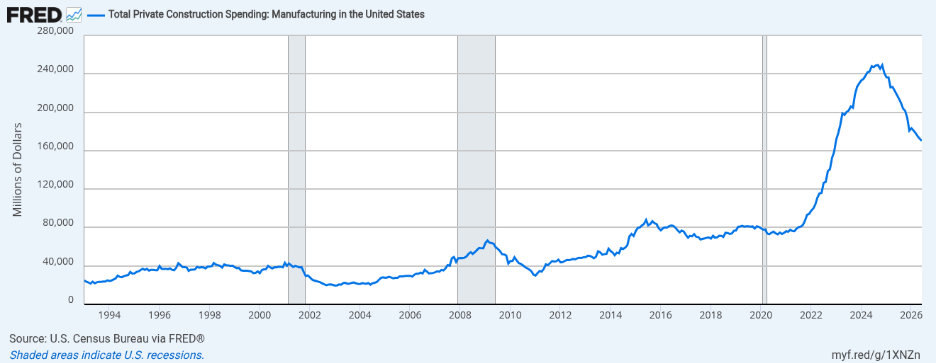
U .S. Census Bureau data show that private construction spending in U.S. manufacturing has fallen dramatically since late 2024—almost as stunningly as it rose from 2022 to 2024. This spending tripled from an annual rate of $80 billion in early 2022 to $249 billion by November 2024, partly in response to federal policies that stimulated private clean manufacturing and innovation. Private construction spending fell back to an annual rate of $170 billion in June 2026.
FRED: Total Private U.S. Construction Spending Between 1994 and 2026
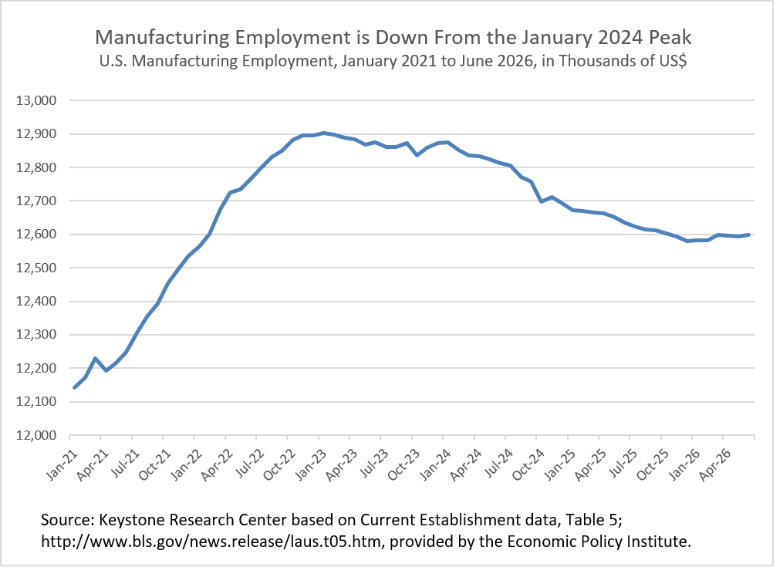
Not surprisingly, this investment dip has been associated with a decline in manufacturing jobs. U.S. manufacturing employment is now 277,000 below its January 2024 level.
Keystone Research Center: Manufacturing Employment Between January 2022 and August 2026
Data on private construction spending in manufacturing does not exist for the four states of the ReImagine Appalachia project—PA, OH, WV, and KY. Another data source, however—the Rhodium/MIT Clean Investment Monitor—does have state and national data on categories of investment boosted by federal policies in 2021 and 2022 but potentially hurt by policy reversals in 2025 (e.g., the cuts to Inflation Reduction Act clean energy investment in the “One Big Beautiful Bill” act). Rhodium/MIT tracks clean manufacturing and energy investments. These data show that, in both the United States and the four-state RA region, clean energy and manufacturing investments in the second quarter of 2026 (the latest data available) were well below the peaks reached during 2024.
Some Positive Signs
There was some good news in the Rhodium/MIT data: consumer spending on clean energy and clean transportation investment increased in the second quarter of 2026 in both the U.S. and the four-state coal country region. The increasing affordability of distributed renewable energy and storage was a powerful enough market force to overcome any tendency of the federal policy U-turn to reduce this consumer spending. As Bill McKibben has highlighted recently, the plunging prices of renewables and now batteries are very good news for accelerating the longer-term transition to a sustainable economy.
Alongside this good news, however, manufacturing investment in clean energy and clean tech in the United States remained 24% below its second-quarter 2025 peak. The next figure shows that the same thing was true for the four-state ReImagine Appalachia region.
In this figure, the light blue portion of the bars (“retail”) shows clean energy investments rising in Q2 of 2026 and, sustained by healthy consumer spending, still at roughly the peak level over the 7 ½ years shown. While there was also an increase in spending on the deployment of clean energy and industry technologies (the dark blue bars) in Q2 2026, spending remains 17% lower than the peak in Q3 of 2024. Manufacturing investment in clean energy and other clean tech (the orange bars) remains 26% below the peak in Q4 2023 (despite a small upward tick from Q1 2026 to Q2 2026).
Keystone Research Center: Consumer Spending Has Driven Up Clean Energy Investments
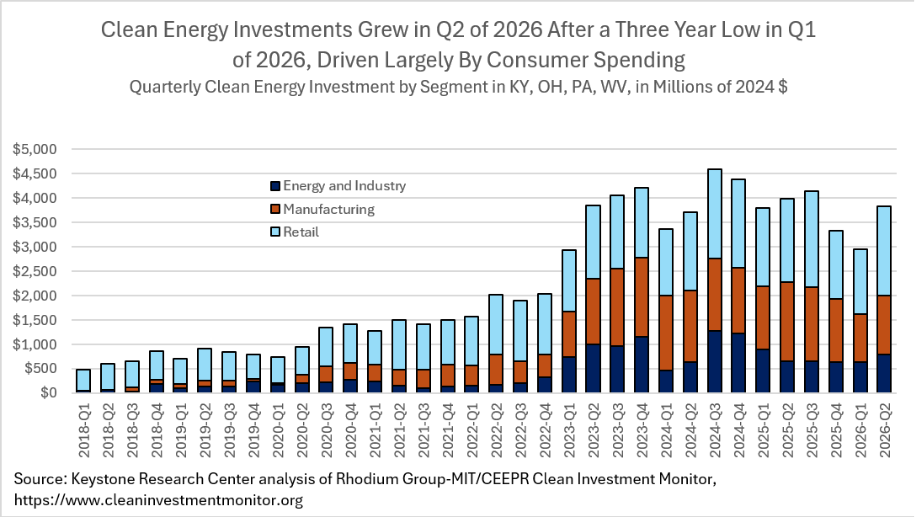
Across all three categories shown in the previous figure, after the Infrastructure Investment and Jobs Act (IIJA), the Inflation Reduction Act (IRA), and the CHIPS and Science Act were signed into law in 2021 and 2022, total federal clean energy investments began to increase in the four-state Appalachian region. These investments peaked in quarters three and four of 2024. Since then, aggregate investments across these three categories have fallen.
The resilience of consumer spending on clean energy and transportation offers hope for the future. But the federal policy reversal on clean energy last year has had clear negative short-term impacts, shown most dramatically in the first chart in this blog. In early 2028, under a new Congress, and in early 2030, the next presidential term, we need a second reversal in federal policies. Getting private construction spending in manufacturing growing rapidly again—rather than continuing the free fall of the past 20 months—is vital to manufacturing communities in coal-country Appalachia and across the United States. It is also vital to our regional and national economy, to limiting climate-related disasters, and to public health.