
June 25, 2026
The recent stress on the Strait of Hormuz has led to spikes in crude oil prices as major oil transportation routes are cut off. While many people worry about the rising costs of fuel, they may not predict the associated price hikes for the plastic supply chain.

According to the latest figures from UN Trade and Development (UNCTAD), crude oil prices have increased from $69 to $113 per barrel as of late April, 2026. Since a large amount of conventional plastics are made from oil, plastic prices are rising too. For instance, UNCTAD estimates that between February and April 2026, the cost of Polyethylene resin, commonly used in packaging, has increased by 70-80 percent. These higher costs present real challenges for companies and consumers.
So what do we do about it? One solution we’re exploring at ReImagine Appalachia is the potential for bio-based plastics. While much of the plastic produced in Appalachia is made from ethane, derived from natural gas, the current oil and gas crisis demonstrates the dangers of relying on limited, non-renewable resources within complex supply chains.
How biomaterials could offer critical solutions
Biomaterials made from a range of bio-based sources offer an opportunity to diversify the plastics supply chain and reduce the risk of price volatility moving forward. Manufacturing these goods will not only help ensure the long-term viability of the region’s plastics industry, it will also support the region’s agricultural sector.
With bio-based plastics, Appalachia has the unique opportunity to own the whole production from growing to processing to distribution, and its central location positions it to deliver products to major markets via road, rail, and waterways. This is a strong asset in light of the trend of global tariffs on the trade of bio-based materials averaging 14.4 percent compared to trade of conventional plastics which are average 7.2 percent. Producing bioplastics domestically in Appalachia avoids import costs, reduces transportation emissions given the region’s central location to major US markets, and makes use of historic manufacturing and agricultural expertise. Furthermore, forecasts show the compound annual growth rate for the domestic bioplastics market to be around 17.5 over the next eight to ten years, compared to the 4 percent to 5 percent growth projected for domestic plastics overall.
West Virginia has a competitive edge for building a biomaterials economy
Appalachia’s unique assets position the region to become a leader in the bioplastics sector; with the right strategic investments, public policy, and infrastructure developments, bioplastics production could support good jobs growing the bio-based feedstocks, processing the resins, and manufacturing the final products. The bioplastics sector has the potential to build lasting local prosperity within the region while contributing to impactful global sustainability efforts.
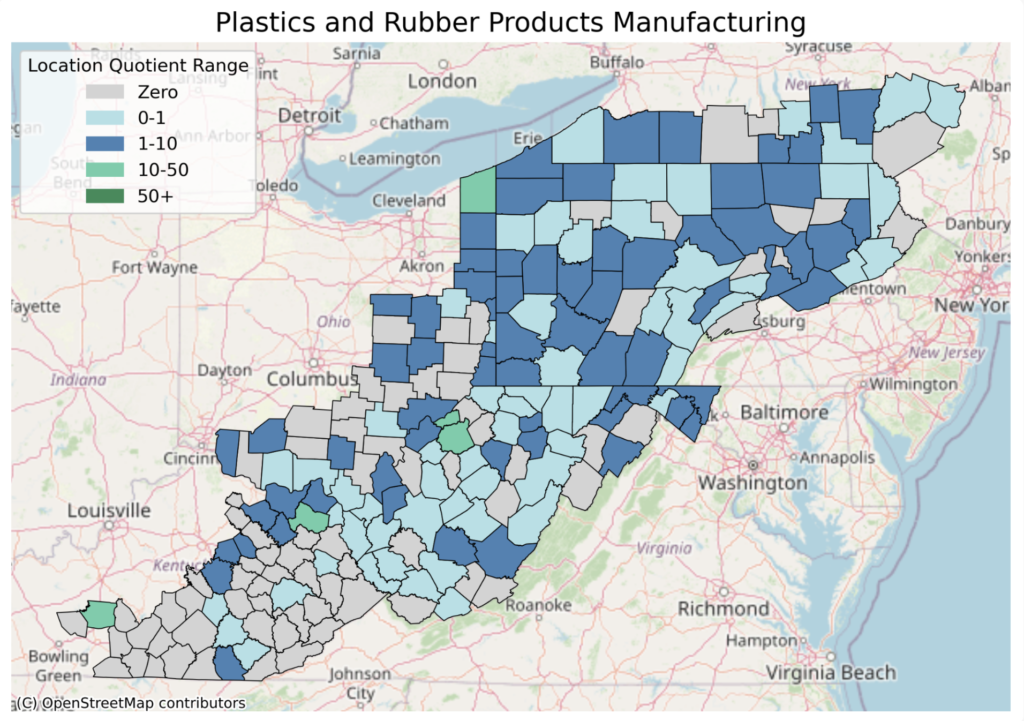
West Virginia, in particular, could be a central hub for regional bioplastics manufacturing. ReImagine Appalachia did GIS mapping of manufacturing strength in the region. The data reveal an already high concentration of employment in plastics manufacturing within several West Virginia counties. This matters because researchers have succeeded in identifying ways for plastics manufacturers to begin incorporating bio-based feedstocks. Investing in the bioplastics sector within West Virginia and the broader Appalachian region can support opportunities for manufacturers and workers, biomaterial processors, and farmers who all play a part in this high value-add industry.
The vital role of community-led agriculture
Bioplastics can be made from a range of natural materials that grow well in the region, including those that do not compete with food production! For instance, industrial hemp is a plant with a long and largely forgotten history in Appalachia. This plant makes a great biomaterial for many applications, from construction materials to bioplastics. The grain of the plant is a protein-rich food source, and it can make a valuable part of a farmer’s crop rotation that increases soil health. The fibers in the stalk of the hemp plant are processed into the bioplastic feedstocks. Corn and sorghum were also identified as other good options in ReImagine Appalachia’s research on the subject, but it is even possible to create bioplastics out of non-edible agricultural and food waste.
Addressing processing challenges in the state
Another key challenge in transforming this plant matter into usable feedstock is processing. There is currently a lack of biomaterial processing facilities in the region, especially for industrial hemp. This is an issue that needs to be addressed in order to support a truly thriving bioplastics and larger biomaterials industry within the region. ReImagine Appalachia is hosting a gathering in Huntington in July to propose policy solutions and gather local feedback on how to address local processing challenges.
While hurdles remain in this still developing sector and bioplastics are by no means a perfect solution on their own, the benefits of a renewable, flexible supply chain built on new innovation in alignment with rising customer demand cannot be ignored! Bioplastics are not just a far-off dream. There are already examples of this work being done. Appalachia deserves an industry built not of pollution or extraction, but one that can generate sustainable prosperity within local communities, connecting a circular system of agriculture and manufacturing in an inspiring way. This is the future, and now is the time for Appalachia to bring it into the 21st Century!