
This article recaps of some of the key points from ReImagine Appalachia’s recent in-depth report on repurposing the waste heat generated by data centers.

Virginia’s legislature is officially the first in the United States to pass legislation to advance waste heat recycling methods for data centers. HB323 directs the commonwealth’s Department of Energy to explore heat reuse practices and provide recommendations to the state to encourage more responsible development. Waste heat recovery is building momentum. So, let’s review why data centers generate so much heat, potential uses for excess heat, the cost savings and environmental benefits of heat recycling, and policy incentives that could help make this practice the standard.
As the artificial intelligence (AI) industry grows, so too does the demand for the data centers that power them. The companies that build these facilities have also eyed rural Appalachia for potential data center sites. As important as these facilities are for the modern world, many communities are concerned about their potential impacts. The economic benefits of data centers are often underwhelming and these facilities consume large amounts of electricity and water while releasing their excess heat into the surrounding area.
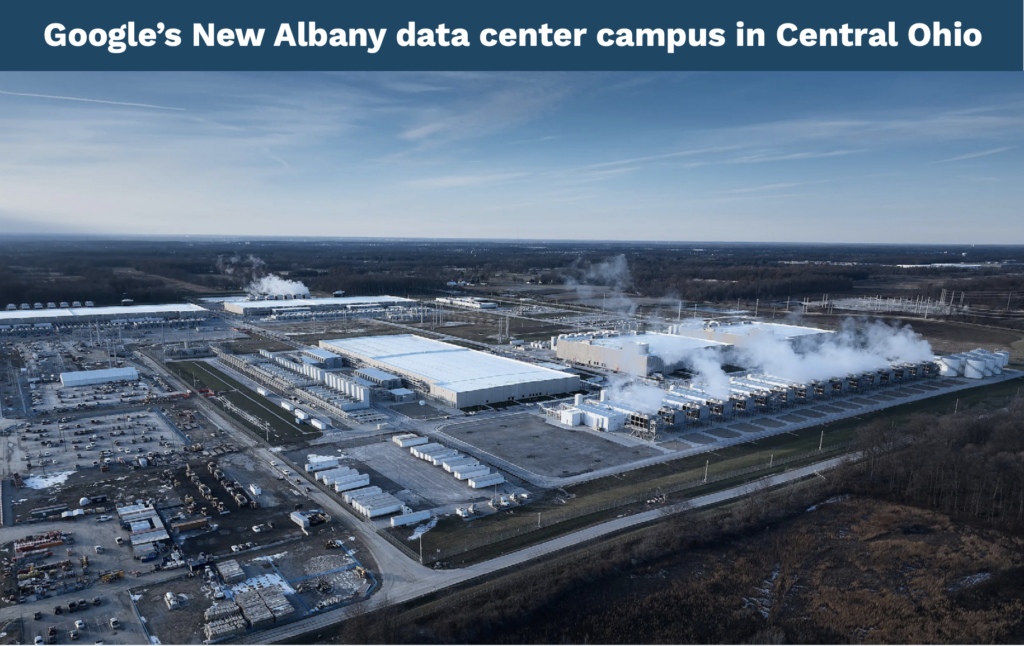
Source: Google, Accessed December 2025
But what if that leftover heat could be recycled and become a resource instead of a waste? Heat is a form of energy after all.
That’s the core idea behind our new report: Catching Heat: Using Waste Heat Generated from Data Centers, a new report from ReImagine Appalachia.
The report highlights the potential for transforming waste heat into economic, environmental, and community benefits — especially in places like Appalachia, where rural economies seek new opportunities and energy challenges are both acute and familiar.
Recycled heat could be used to heat community buildings and actually lessen the burden on the electric grid instead of worsening it. Heat recycling could even reduce greenhouse gas emissions.
How Data Centers Generate Heat
Think of your cellphone. Has it ever warned you that it is overheating and cannot be used until it cools down? Data centers work similarly.
At their core, data centers are warehouses full of computing equipment, like processors, memory, storage, and networking gear, all crunching data around the clock. These intense computing processes generate heat, similar to how a smartphone gets warm when running too many apps. Because servers must stay within strict temperature limits to operate reliably, data centers rely on cooling systems that move this heat away from the equipment.
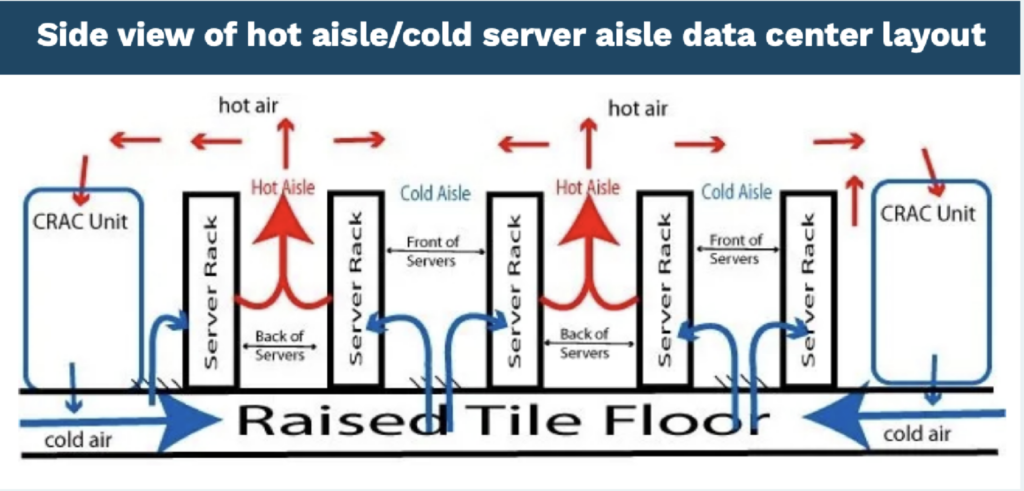
Source: U.S. Department of Energy, Accessed December 2025
Most data centers are currently cooled through air conditioning systems where cool air is fed to the computing hardware from the floor, and hot air is filtered out from the top. Similarly, laptop and desktop computers use fans to bring in cool air and expel hot air. Some newer data centers are utilizing liquid cooling systems where excess heat is stored in water instead of air.
Whether through air conditioning units, water-based systems, or advanced liquid cooling, much of the electricity fed into a data center eventually becomes heat. That heat is usually released into the atmosphere. It is essentially wasted even though it represents a substantial pool of energy that could be reused.
From Waste to Warmth: How District Heating Can Distribute Heat
Capturing and using this waste heat isn’t simple, but it is technically viable with the right infrastructure. One promising model is district heating networks, which are systems of insulated underground pipes that distribute heat from a central source to multiple end users, such as homes, schools, hospitals, or businesses.

Instead of letting heat escape into the air, a data center could send that heat into a network that warms nearby buildings or supports industrial processes. Many universities, hospitals, research centers, military bases, airports, and industrial facilities already use these systems. In fact, Pittsburgh’s Northshore uses such a system to support the Andy Warhol Museum, PNC Park, the Carnegie Science Center, and Allegheny General Hospital.
Another kind of system is a thermal energy network (TEN) where multiple buildings are connected via pipes to supply and receive heat between them.
The Opportunities: Energy, Water, Money, and Communities
Why does this matter beyond clever engineering? The report highlights multiple compelling community benefits:
Lower Energy Consumption & Costs: Reusing data center waste heat can replace electricity consumption for heating, lowering community energy costs.
Water Savings: Many data center cooling systems rely on water. Capturing and reusing heat can reduce the strain on local water resources.
Emission Reductions: Turning waste heat into productive energy cuts greenhouse gas emissions and local air pollutants by replacing fossil-fuel heating sources.
Community Benefits: Heating schools, public buildings, greenhouses, or industrial facilities with low-cost thermal energy creates visible and tangible community impact. Recycled heat could be especially useful for warming greenhouses to boost local food production.
Policy Steps to Make Heat Recycling a Reality

- The potential is clear but real impact depends on policy and planning. The Catching Heat report outlines several steps policymakers can take to ensure new data center developments deliver heat reuse benefits:
Regulatory Streamlining:
- Reduce time and uncertainty by clarifying requirements and coordinating reviews through a single, predictable process.
Project Development Support:
- Provide county-level funding to identify where heat-transferring infrastructure could be developed and publish integrated maps showing utilities, fiber, water, and potential anchor loads (reliable customers who will consistently require the heat, such as schools and hospitals) to certify them as “thermal-ready.”
- Develop and distribute standardized “shovel-ready” site cards (documents that outline the key project details with uniform terms and conditions to streamline development. This includes goals, timeline, scope, and budget.
- Offer Front-End Engineering Design (FEED) and feasibility study grants to evaluate project viability and develop interconnection models.
Fiscal Incentives:
- Establish flexible capital incentives, including:
- A refundable or transferable tax credit for qualified thermal network and heat pump infrastructure. Transferrable tax credits allow those who have received more in tax credits than what they own in taxes to sell those credits to other entities who may owe more in taxes in exchange for cash. This allows for more efficient circulation of capital.
- A sales and use tax exemption with accelerated depreciation for eligible thermal equipment. Equipment and construction materials depreciate over time, and costs of repairs, replacements, and breakdowns will eat into any profits generated. Because of this, the government gives tax deductions for depreciation every year. The amount of the deduction depends on the equipment or the materials in question, but often the deduction comes in a fixed amount every year. However, with an accelerated depreciation tax model, the deductions are bigger in the early years and lessen over time. So, with this model, a business gets to hold on to more money sooner. This can encourage more businesses to engage with new economic opportunities such as waste heat recovery.
- Award a local property tax abatement for 5-10 years for projects that include thermal energy networks.
- Provide siting incentives and integrated planning. Tax incentives could be provided to entities that not only adopt data center waste heat recovery methods, but also to those that integrate other sustainable development practices. This could include developing data centers with heat recycling systems on top of brownfields or in redeveloped shuttered coal plants, or by co-locating them near greenhouses for waste heat reuse. Special tax incentives could be provided to integrated development plans like this.
- Provide a time-limited and technology-neutral production incentive that rewards verified thermal energy delivery. This could encourage more rapid development in low-income and underserved census tracts.
These actions create a framework where data centers are not just isolated cloud facilities but active contributors to local energy efficiency and community resilience.
Conclusion
Data waste heat from data centers does not have to be a byproduct. With intentional design, robust infrastructure, and smart policies, this waste heat can become a resource that saves money, reduces environmental impact, and strengthens community infrastructure. This is especially true in places like Appalachia, where economic and energy burdens often intersect.